
250 pages · Printable PDF · Instant download
- Instant downloadYours right after checkout
- Secure checkoutCard (Stripe) or PayPal
- Read anywherePhone, tablet or computer, or print it

Paperback sold separately. As an Amazon Associate I earn from qualifying purchases.
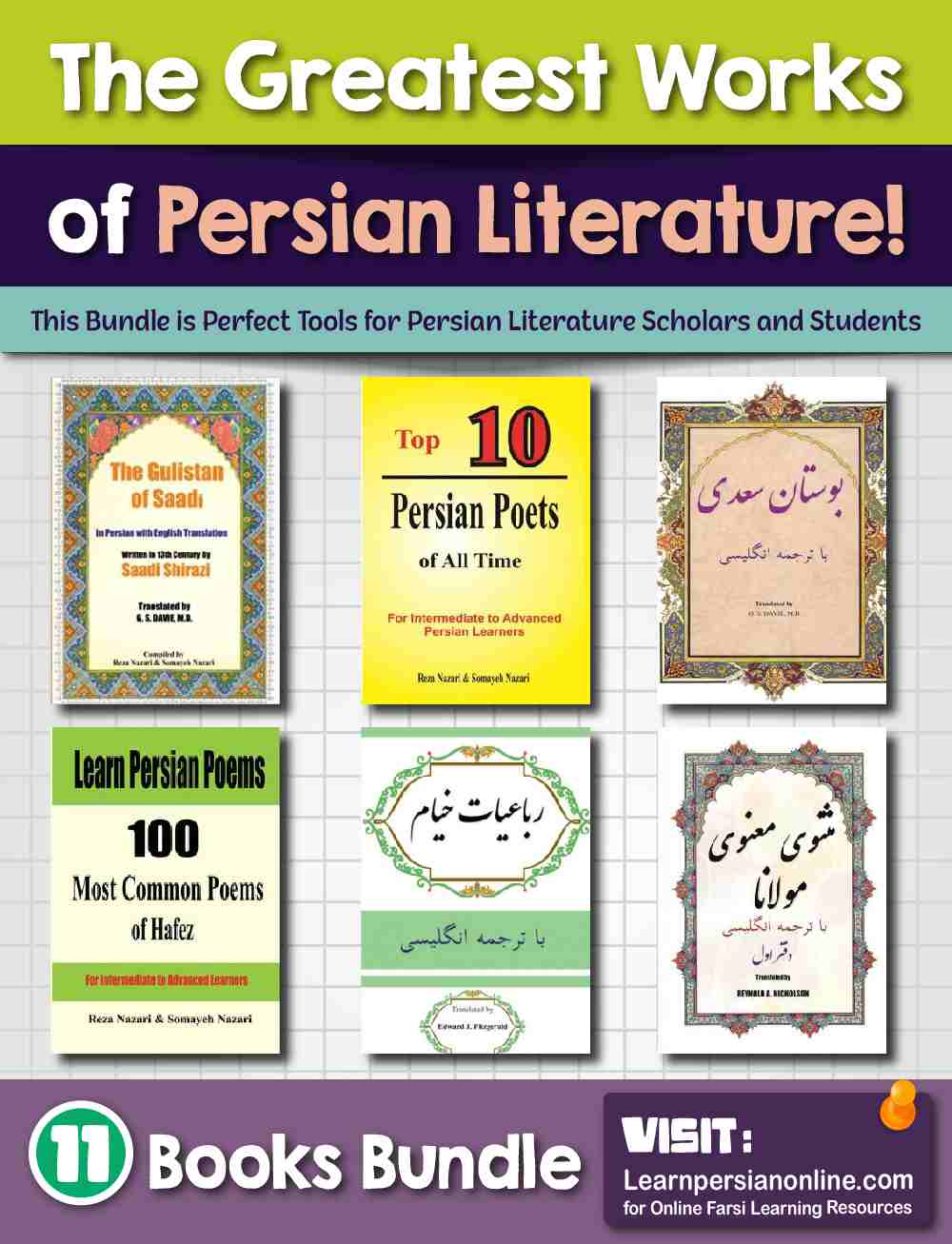
Learn Persian Poems 100 Most Common Poems of Hafez
Learn Persian Poems: 100 Most Common Poems of Hafez gives 100 well-known ghazals from the Divan of Hafez in the original Persian, numbered from 100 down to 1. Difficult words are glossed in English under each poem, and the English translation by Henry Wilberforce Clarke follows. A Persian introduction covers Hafez’s life, key words and fâl-e Hâfez. 250-page PDF by Reza Nazari and Somayeh Nazari.
Read the ghazals Iranians know by heart, with the hard words explained
Hafez is the poet Iranians quote in conversation, open on Nowruz and Yalda night, and read for a fâl. His ghazals are also hard: the vocabulary is old and many words carry two meanings. 100 Most Common Poems of Hafez helps by glossing the difficult words of each poem in English, right under the Persian text.
The book starts with Hafez’s life in simple Persian, with footnoted vocabulary, then explains three key words of his poetry: rend, sufi and mey (wine). The ghazals follow from number 100 to number 1, so the best-known poems come last. Each Persian page is followed by Clarke’s English, which opens: “Not every beloved one that up-kindleth his face the work of a heart-ravisher knoweth.”
At a glance
What is inside
Most of the book is poetry, but the Persian introduction is useful reading practice in its own right.
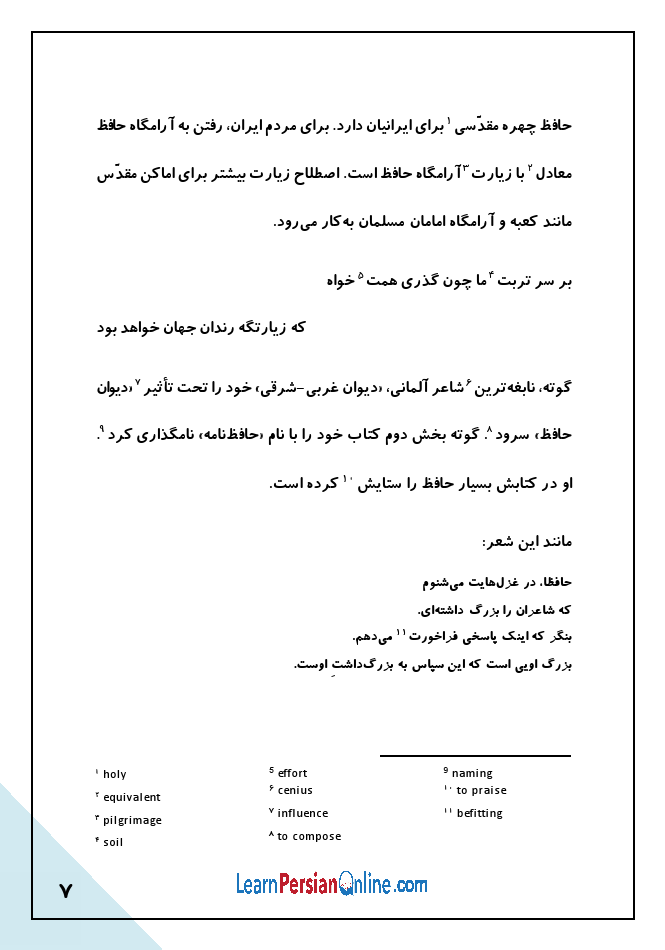
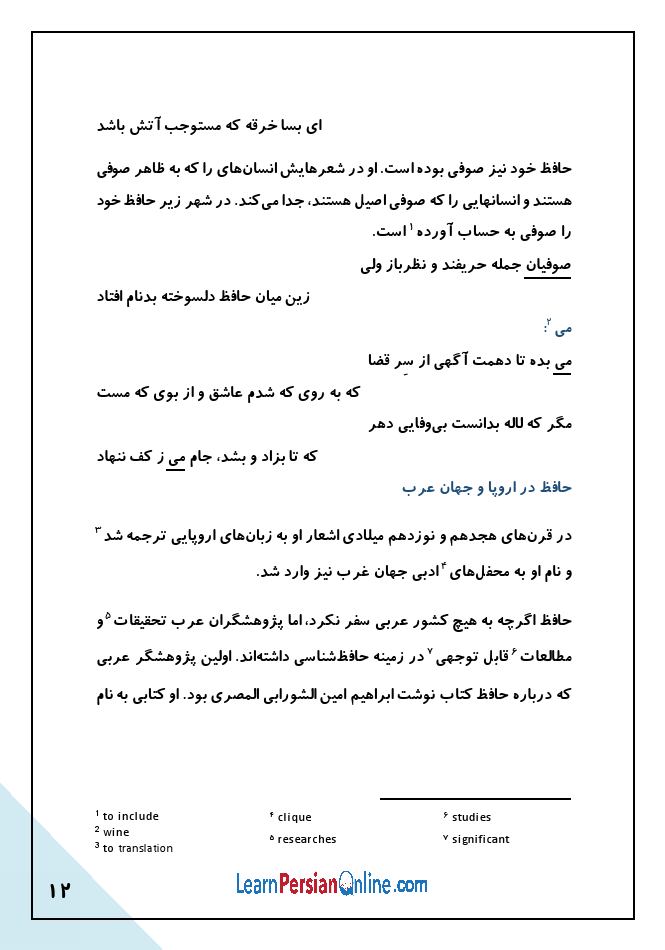
The life of Hafez, in Persian
His birth and death in Shiraz, the kings he served, his job at the royal treasury, and Hafez Day, held at his tomb each autumn. Hard words are glossed in footnotes.
Key words: rend, sufi, mey
Short Persian explanations of the words that recur in the Divan, such as how Hafez turns رند (rend, a clever, reckless person) into a positive word.
Hafez abroad and fâl-e Hâfez
How Goethe and Nietzsche wrote about Hafez, Arab scholarship on his work, and how families take a fâl from his book on Nowruz and Yalda night.
100 ghazals
Each ghazal in Persian, with the line pairs laid out as in the Divan and a numbered list of English meanings for the harder words.
Clarke’s English translation
The full English version of each ghazal on the following page, by Henry Wilberforce Clarke, in his literal, old-fashioned style.
Words glossed in the book
Under each ghazal, the book lists the meaning of words learners are unlikely to know. A few from ghazals 70, 40 and 39:
| Persian | Pronunciation | Gloss in the book |
|---|---|---|
| دیجور | deyjur | dark |
| مقدور | maghdur | possible |
| معذور | ma’zur | excused |
| ملاحت | malâhat | beauty |
| خشت | khesht | brick |
Ghazal 39 is the one that opens عیب رندان مکن ای زاهد پاکیزهسرشت (do not find fault with the rends, O pure-natured ascetic). Read more about the custom of the fâl in our fâl-e Hâfez guide.
Contents
The book is arranged in two parts:
- Description (in English)
- حافظ شیرازی: the life of Hafez, in Persian with glossed words
- دیوان حافظ: the Divan and its themes
- Key words in Hafez’s poetry: rend, sufi and mey
- Hafez in Europe and the Arab world
- فال حافظ: taking a fâl with the Divan
- غزلیات حافظ: ghazals 100 to 1, each in Persian with glosses and Clarke’s English
How to study with this book
- Read the Persian introduction first; it teaches the vocabulary you will meet in the poems.
- Take one ghazal at a time. Read the Persian aloud, then check the glossed words under it.
- Try to say what each line means before you turn to Clarke’s English.
- Memorize one line you like from each ghazal; Iranians often use such lines as sayings.
- Check your knowledge of the classical poets with the free Persian poetry quiz.
Who this book is for
A good fit if you
- read Persian at an intermediate or advanced level and want to start on classical poetry
- want the Persian text and an English version side by side
- are curious about the lines Iranians quote and use for a fâl
- like learning vocabulary from short, glossed texts
Look elsewhere if you
- are still learning to read modern Persian; build up first with 100 Short Stories in Persian
- want a modern, free-flowing English translation; Clarke’s 19th-century version is literal and archaic
Use it with
- Rubaiyat of Khayyam: the same bilingual format for Khayyam’s quatrains.
- Top 10 Persian Poets of All Time: a wider tour of the classical poets.
- Persian poetry on the site: free sections of the Masnavi and the Bustan.
Common questions
What level do I need?
The book is written for intermediate to advanced learners. You should read Persian script comfortably, since the poems and the introduction are not transliterated.
Whose English translation is it?
The translation is by Henry Wilberforce Clarke (1840-1905). It follows the Persian closely, so it is useful for study, though the English is old-fashioned.
Are the poems in Persian script?
Yes. Every ghazal is printed in Persian, with English glosses for the harder words.
How are the poems ordered?
They are numbered from 100 to 1. The book describes this order as running from the less popular poems to the most popular.
What do I get after I buy?
A 250-page PDF to download right after checkout and read on a phone, tablet or computer, or print.
Is there a paperback?
Yes, the paperback is sold on Amazon. The PDF here is the digital edition.
Related Persian books
More Persian learning books on similar topics.
 Learn Farsi in 100 Days: Book + Workbook (2 PDF Ebooks)
$18.74Black Friday


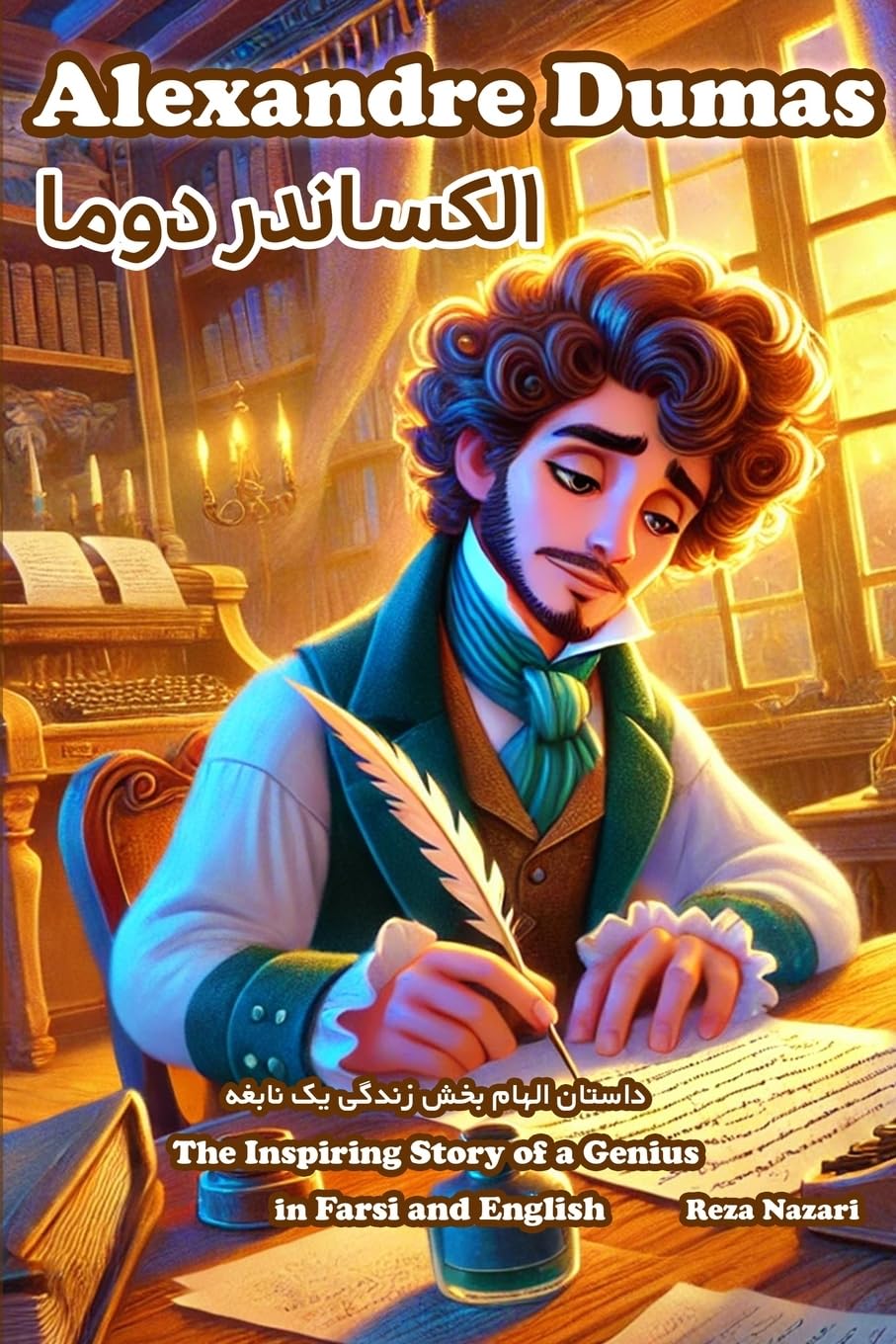 Alexandre Dumas: The Inspiring Story of a Genius in Farsi and English
$9.74Black Friday







What do you think about "Learn Persian Poems" book?
You must be logged in to post a review.
Product Reviews
There are no reviews yet.