


98 pages · Printable PDF · Instant download
- Instant downloadYours right after checkout
- Secure checkoutCard (Stripe) or PayPal
- Read anywherePhone, tablet or computer, or print it

Paperback sold separately. As an Amazon Associate I earn from qualifying purchases.
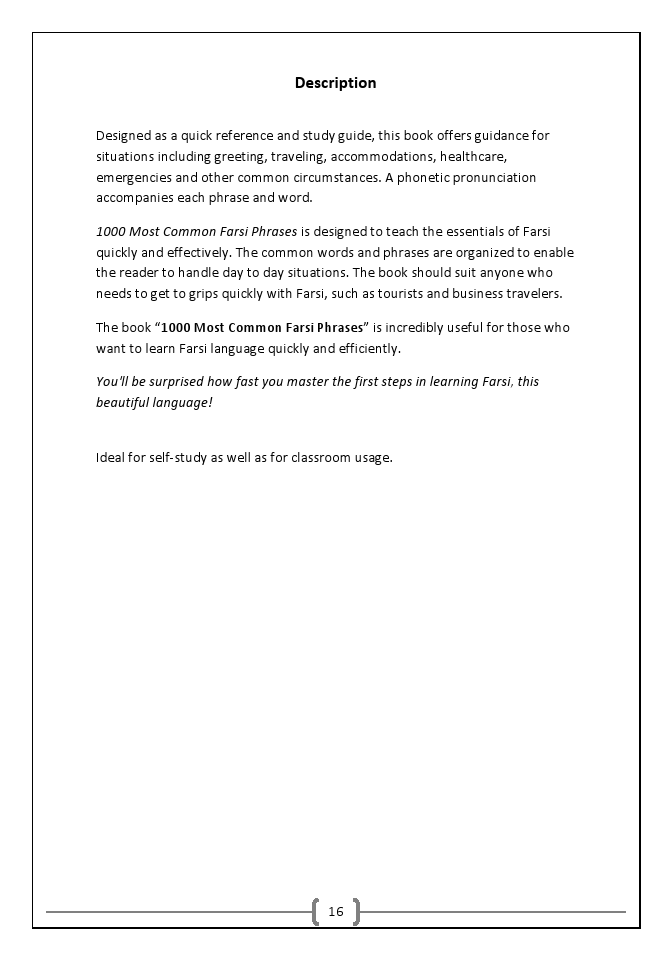
1000 Most Common Farsi Phrases Essential Expressions for Communicating in Farsi
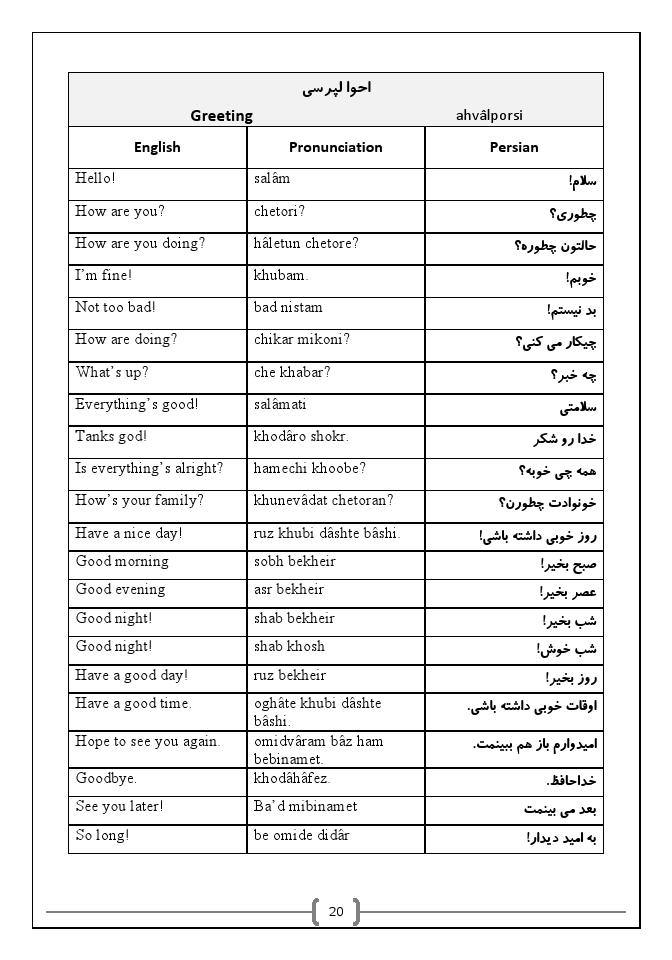
1000 Most Common Farsi Phrases gathers everyday spoken Persian into more than 60 one-page topics, from Greeting and Thank You to Making a Complaint, Taxi, Health and Illness and Shopping. Every line gives the English, a pronunciation in Roman letters and the Persian script, in the colloquial forms people use in Iran, such as خوبم (khubam, I’m fine). 98-page PDF, first edition, by Reza Nazari and Mehdi Parvin.
Read the first 14 pages free (PDF).
Say everyday things in Farsi the way people actually say them
Textbooks teach written Persian, but in conversation people ask حالتون چطوره؟ (hâletun chetore?, how are you doing?) with shortened spoken endings. This first edition of 1000 Most Common Farsi Phrases collects those short spoken sentences and sorts them by what you want to do: thank someone, disagree, ask a question, wait, invite or say no.
Each topic is a three-column table of English, pronunciation and Persian, usually one page long. Under Answer to Thank you, for example, you find خواهش میکنم (khâhesh mikonam, you’re welcome) next to casual replies such as مشکلی نیست (moshkeli nist, no problem).
At a glance
What the phrases cover
The topics are about things people do and feel, rather than places, so they work in any conversation.
Thanks and apologies
Thank You, Answer to Thank you, To Apologize and Answer to apologize give several ways to say each, from ممنون (mamnun) to خیلی ممنونم (kheili mamnunam).
Opinions and arguments
To Agree, To Disagree, Certainty, Uncertainty, Expression of Opinions and Making a Complaint, with lines like موافق نیستم (movâfegh nistam, I don’t agree).
Asking questions
Question words and short questions such as کجا؟ (kojâ?, where?), چرا؟ (cherâ?, why?) and ساعت چنده؟ (sâ’at chande?, what time is it?).
Social life
Parties, invitations accepted and refused, marriage, compliments, phone calls, promises, and giving or receiving bad news.
Practical topics
The Weather, Time & Date, Taxi, To Give Address, Shopping, and Health and Illness, with symptoms such as سرم درد میکنه (saram dard mikone, I have a headache).
Pronunciation key
A symbol table at the front explains the transliteration, including â, kh, gh and the ‘ for a slight pause.
From the topic To Disagree
A few of the 21 ways the book gives to say no, from mild to firm:
| English | Pronunciation | Persian |
|---|---|---|
| No. | na | نه |
| I don’t agree. | movâfegh nistam | موافق نیستم. |
| I don’t think so. | fekr nakonam | فکر نکنم. |
| No, that’s not true. | na, dorost nist | نه، درست نیست. |
| It’s not possible. | emkân nadâre | امکان نداره. |
For the polite ways Iranians soften a refusal, read the free guide to ta’ârof.
Contents
The topics in book order, grouped by page range:
- Pronunciation key (page 17)
- Greeting, Thank You, To Apologize and their answers, Introducing (pages 20 to 25)
- To Love, Like and Dislike, To Agree, To Disagree, To Ask Questions, Understanding (26 to 31)
- Family, Clarification, Making a Complaint and answering one, To Forget and To Remember (32 to 36)
- Fatigue, To Wait, Being Happy and Sad, Blaming, Watching TV, To Help (37 to 42)
- Party, To Invite, Accepting and Refusing Invitations, Certainty, Uncertainty, To Request (43 to 49)
- Feelings and Blessing, To be Shocked, To Praise, The Weather, Time & Date, Warning, Opinions (50 to 56)
- Marriage, Apartment / House, Feelings, Offers and Requests made, accepted or refused (57 to 63)
- Job, Future, News, Bad News, Describing Personality, To Give Address (64 to 69)
- Sleep, Taxi, Compliments, Phone Calls, Age, Promises and Useful Responses (70 to 75)
- Speaking in Farsi, Asking for Opinions, Hope and Disappointment, Health and Illness, Shopping (76 to 80)
How to use this phrasebook
- Read the pronunciation key once: â is the long a in father, and kh and gh are the two throat sounds.
- Take one topic a day. Cover the Persian column, read the English, and say the phrase aloud.
- Choose the three phrases from each topic you would really use and copy them in Persian script.
- Use them in short exchanges, following the free Farsi conversation lessons.
- Check your greetings and replies with the Persian greetings quiz.
Who this book is for
A good fit if you
- want ready-made spoken sentences rather than grammar rules
- need polite replies for thanks, apologies, invitations and compliments
- can rely on the transliteration while you learn the script
- like to study one short page at a time
Look elsewhere if you
- prefer the newer printing; the second edition lists the same topics in a 90-page PDF
- need phrases for flights, hotels, the police and other travel situations; Easy Persian Phrasebook is arranged that way
Use it with
- Spoken vs written Persian: why the phrases say امکان نداره instead of the written امکان ندارد.
- Farsi Conversations: full dialogues that use phrases like these in context.
- Top 1,500 Persian Words: vocabulary to swap into the phrases.
Common questions
Is this spoken or written Persian?
Mostly spoken. The phrases use everyday Iranian forms such as نمیدونم (nemidunam, I don’t know) where written Persian has نمیدانم.
Do I need to read the Persian alphabet?
No. Every phrase has a pronunciation in Roman letters, so you can use the book before you learn the script.
Does it teach grammar?
No. It is a phrase collection, not a course, so there are no grammar lessons or exercises.
How does it differ from the second edition?
Both list the same topics, from Greeting to Shopping. This is the 2017 first edition by Reza Nazari and Mehdi Parvin, as a 98-page PDF; the second edition is 90 pages.
What do I get after I buy?
A 98-page PDF you can download right after checkout and read on a phone, tablet or computer, or print.
Is there a paperback?
Yes, the paperback is sold on Amazon. The PDF here is the digital edition.
Related Persian books
More Persian learning books on similar topics.
 Learn Farsi in 100 Days: Book + Workbook (2 PDF Ebooks)
$18.74Black Friday


 Alexandre Dumas: The Inspiring Story of a Genius in Farsi and English
$9.74Black Friday






Product Reviews
What do you think about "1000 Most Common Farsi Phrases" book?
You must be logged in to post a review.
dulce llaras vilaplana –
It was really helpful.
Learn Persian Online Team –
Thank you for your positive feedback!