Pasargad (Pasargadae): Cyrus the Great’s Capital and Tomb
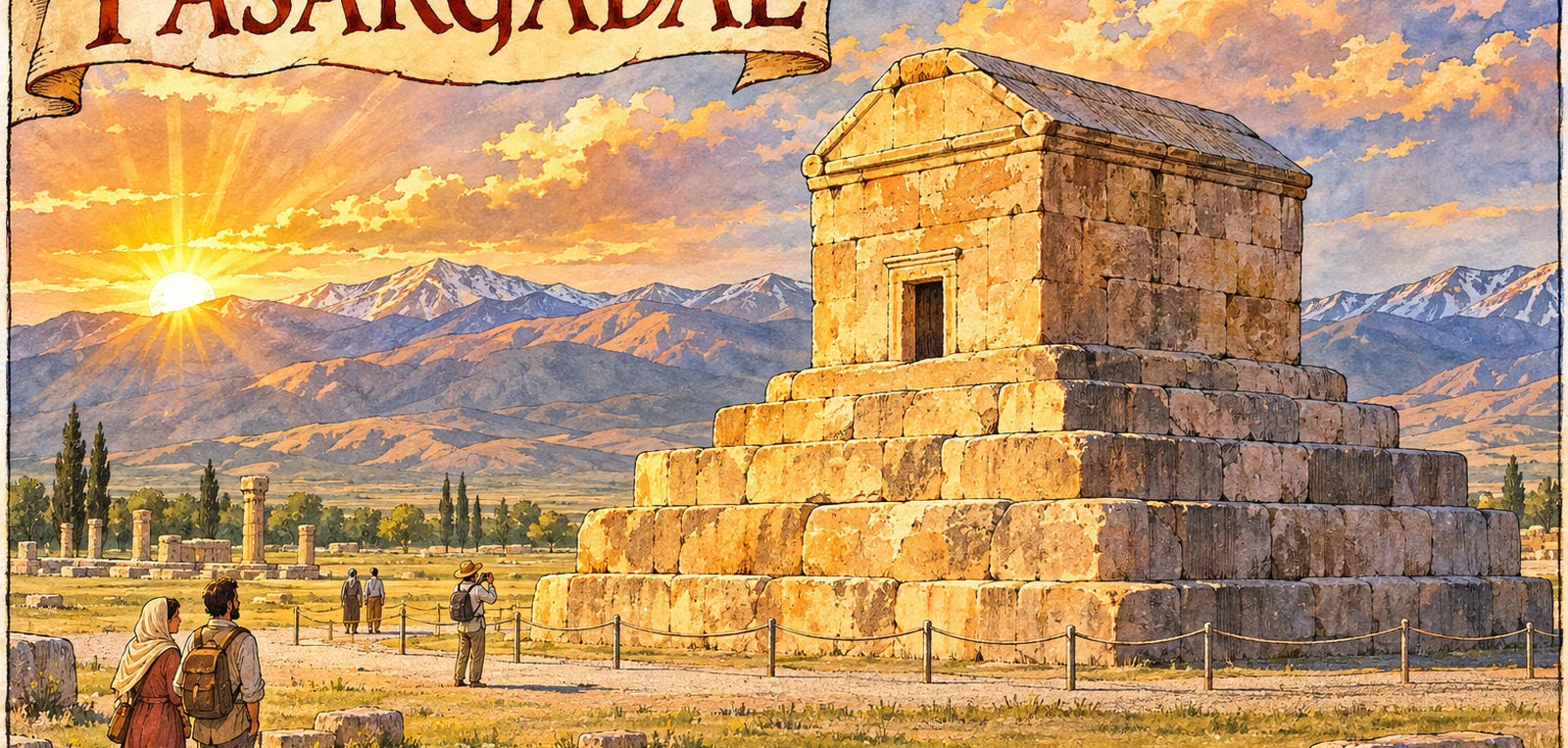
Pasargad, or Pasargadae (پاسارگاد, Pâsârgâd), was the first capital of the Achaemenid Persian Empire, founded by Cyrus the Great in the 6th century BC. Its ruins lie on the Morghab plain in Fars province, Iran, about 87 km northeast of Persepolis. The site includes the tomb of Cyrus, palaces, a royal garden and a stone tower, and it has been a UNESCO World Heritage site since 2004.

Pasargadae at a glance
| Fact | Details |
|---|---|
| Persian name | پاسارگاد (Pâsârgâd); Greek form Pasargadae |
| Location | Morghab plain (دشت مرغاب, dasht-e Morghâb), Pasargad County, Fars province |
| Altitude | about 1,900 meters above sea level |
| Founded by | Cyrus the Great (کوروش بزرگ), 6th century BC |
| Distance | about 87 km northeast of Persepolis; Shiraz is the nearest large city |
| UNESCO | World Heritage List, 2004; its royal garden is also part of the Persian Garden listing |
| Main sights | Tomb of Cyrus, Gate Palace, Audience Palace, Private Palace, royal garden, Zendan-e Soleyman, Tall-e Takht |
History of Pasargadae
The Achaemenid Persians came from Persis (پارس, Pârs), the region of today’s Fars. After Cyrus defeated the Medes around 550 BC, he built a new royal center on the plain where, according to tradition, the battle took place. Pasargadae was built in stone, with palaces set in a large walled garden rather than inside a dense city.
After Cyrus, his son Cambyses II ruled the empire, and later Darius I began a grander capital at Persepolis (تخت جمشید, Takht-e Jamshid). Pasargadae remained important as the place of Cyrus’s tomb. Later rulers reused parts of the site, and in the Islamic period the tomb became a local shrine.
For the life of its founder, read Cyrus the Great: life, family and empire.
The monuments of Pasargadae
| Monument | Persian | Pronunciation |
|---|---|---|
| Tomb of Cyrus | آرامگاه کوروش | ârâmgâh-e Kurosh |
| Gate Palace | کاخ دروازه | kâkh-e darvâze |
| Audience Palace | کاخ بار عام | kâkh-e bâr-e âm |
| Private (residential) Palace | کاخ اختصاصی | kâkh-e ekhtesâsi |
| Royal garden | باغ شاهی | bâgh-e shâhi |
| Prison of Solomon (stone tower) | زندان سلیمان | zendân-e Soleymân |
| Throne Hill | تل تخت | tall-e takht |
Tomb of Cyrus the Great
The best preserved monument at Pasargadae is the tomb of Cyrus, about a kilometer southwest of the palaces. It is a small stone chamber with a gabled roof standing on six stepped stone tiers, about 11 meters high in total. No mortar was used: the large limestone blocks were joined with metal clamps.
Greek historians of Alexander the Great, drawing on Aristobulus, describe a golden coffin inside the chamber and say that Alexander found the tomb robbed and ordered it restored. The chamber is empty today. In the Islamic period, the tomb was known as مشهد مادر سلیمان (Mashhad-e Mâdar-e Soleymân, “shrine of the mother of Solomon”).

Audience Palace (Bar-e Am)
The Audience Palace was where the king received visitors. It had a central columned hall with porticoes on all four sides. One tall column still stands, and the bases are made of contrasting black and white stone. Reliefs on the door frames showed figures with human and animal feet, and a short trilingual inscription in Old Persian, Elamite and Babylonian reads “I am Cyrus the king, an Achaemenid.”

Gate Palace and the winged figure
The Gate Palace was the monumental entrance to the royal grounds: a square columned hall with two main doorways and two side doorways. On one of its door jambs is the best known relief at Pasargadae, the “winged man” or four-winged guardian. The figure wears a long robe and an elaborate crown in an Egyptian style, with four wings spreading from the shoulders, and raises one hand. Scholars disagree about what it represents: a protective spirit, a symbol of royal power, or Cyrus himself.


Private Palace
The Private Palace (also called the residential palace, کاخ نشیمن, kâkh-e neshiman) was the king’s own residence, at the northern end of the garden. It had a large columned hall with long porticoes, and fragments of the “I am Cyrus” inscription were found here too. Although much of it has been destroyed, its stone column bases and floor still show the plan.


The royal garden
Between the palaces lay a large garden crossed by narrow stone water channels. It is one of the earliest known examples of the Persian garden design, and it is included in the UNESCO listing of the Persian Garden. Nearby are two white stone platforms, one with steps, which are often interpreted as places for ceremonies or fire rituals.
Zendan-e Soleyman (stone tower)
The stone tower known locally as زندان سلیمان (“Prison of Solomon”) was once a square tower of white limestone with black stone details. Today only one wall, about 14 meters high, still stands. Its purpose is unknown; suggestions include a tomb, a treasury or a building for religious use. A very similar and better preserved tower, the Ka’ba-ye Zartosht, stands at Naqsh-e Rostam near Persepolis.


Tall-e Takht
On a hill north of the palaces is Tall-e Takht, a huge platform of cut stone blocks laid without mortar. It was begun under Cyrus but never finished as planned, and it was later used as a fortified citadel. Remains from several later periods, including the Sasanian era, were found there.

Later buildings: the mosque and caravanserai
In the medieval Islamic period, a small mosque was built around the tomb of Cyrus using columns taken from the palaces. Little of it remains. Near the tomb are also the remains of a caravanserai (an inn for travelers), built with white stones reused from the Achaemenid buildings.


Building materials and style
The palaces combine white limestone with dark stone for column bases and door frames, and they used mud brick and wood for walls and roofs. The architecture mixes traditions from across Cyrus’s empire, including Lydian and Ionian stone masonry, Mesopotamian reliefs and Persian columned halls. Many of these ideas were developed further at Persepolis.

How to visit Pasargadae
- Most visitors come on a day trip from Shiraz, often combined with Persepolis and Naqsh-e Rostam.
- The site is spread out, so allow a few hours and bring water and sun protection: the plain is open and sunny.
- Spring and autumn are the most comfortable seasons. Summer days are hot, and winter mornings can be cold at this altitude.
- Pasargadae is in Fars province, reachable by road from Shiraz.
Useful phrases for the trip are in travel words and phrases in Persian.
Check what you learned about Pasargadae.
1. Who founded Pasargadae?
2. In which Iranian province is Pasargadae?
3. What does زندان سلیمان (zendân-e Soleymân) literally mean?
4. How was the stonework of the tomb of Cyrus held together?
5. When was Pasargadae added to the UNESCO World Heritage List?
6. Which relief is the most famous at the Gate Palace?
Answer key with explanations
- C. Cyrus the Great: Cyrus the Great built Pasargadae as his capital in the 6th century BC.
- A. Fars: Pasargadae lies on the Morghab plain in Fars province.
- A. Prison of Solomon: Zendân means prison. It is the local name of the ruined stone tower.
- B. With metal clamps, no mortar: The blocks were joined with metal clamps and no mortar was used.
- B. 2004: Pasargadae was inscribed in 2004.
- B. The four-winged figure: The four-winged guardian figure is carved on a door jamb of the Gate Palace.
Common questions
What is Pasargad?
Pasargad (Pasargadae) is the archaeological site of the first Achaemenid capital, built by Cyrus the Great in Fars province, Iran. It contains his tomb, palaces and a royal garden.
Is Pasargadae the same as Persepolis?
No. Pasargadae was Cyrus the Great’s capital. Persepolis (Takht-e Jamshid) was begun later by Darius I, about 87 km to the southwest.
Is Cyrus the Great buried at Pasargadae?
Yes. His stone tomb stands on the plain about a kilometer southwest of the palaces, and it is the best preserved monument at the site.
When did Pasargadae become a UNESCO World Heritage site?
Pasargadae was inscribed on the UNESCO World Heritage List in 2004.
How far is Pasargadae from Shiraz?
It is a day trip by road from Shiraz, usually done together with Persepolis.
More historical sites of Iran: Persepolis, Naghsh-e Jahan Square, Golestan Palace, Saadabad Complex and the historic city of Rey. Test yourself with the Iran quiz.
More in our Iran section: Visiting Pasargadae, Pasargadae as a capital and the tomb of Cyrus.
Learn Persian with our bestseller
Serious about Persian? Get all 30 of our Persian learning books for $149.00 (55% less than buying them one by one).
Free Persian Starter Kit (PDF)
The Persian alphabet chart and the 101 most common Persian words with pronunciation, in one printable PDF. You also get a one-time 15% code for any of our books.
We will email you new lessons and book news from Learn Persian Online. Unsubscribe any time.Free Persian Starter Pack: Alphabet + 100 Core Words
Get the 14-page printable Starter Pack (all 32 letters, a 7-day reading plan, 100 core words and 20 survival phrases) and a short 5-email course. Free.
by: Reza about (category: Blog)

Reza is an experienced Persian instructor who has been tutoring students since 2008. He is the founder of Learn Persian Online, a tutoring company that has helped many students learn Persian, this beautiful language. He works with students individually and in group settings, he tutors both live and online Persian courses. Reza provides an individualized custom learning plan and the personalized attention that makes a difference in how people view Persian learning process.


What people say about "Pasargad (Pasargadae): Cyrus the Great's Capital and Tomb"?
No one replied yet.