Shomal, Iran: A Guide to Northern Iran and the Caspian Coast
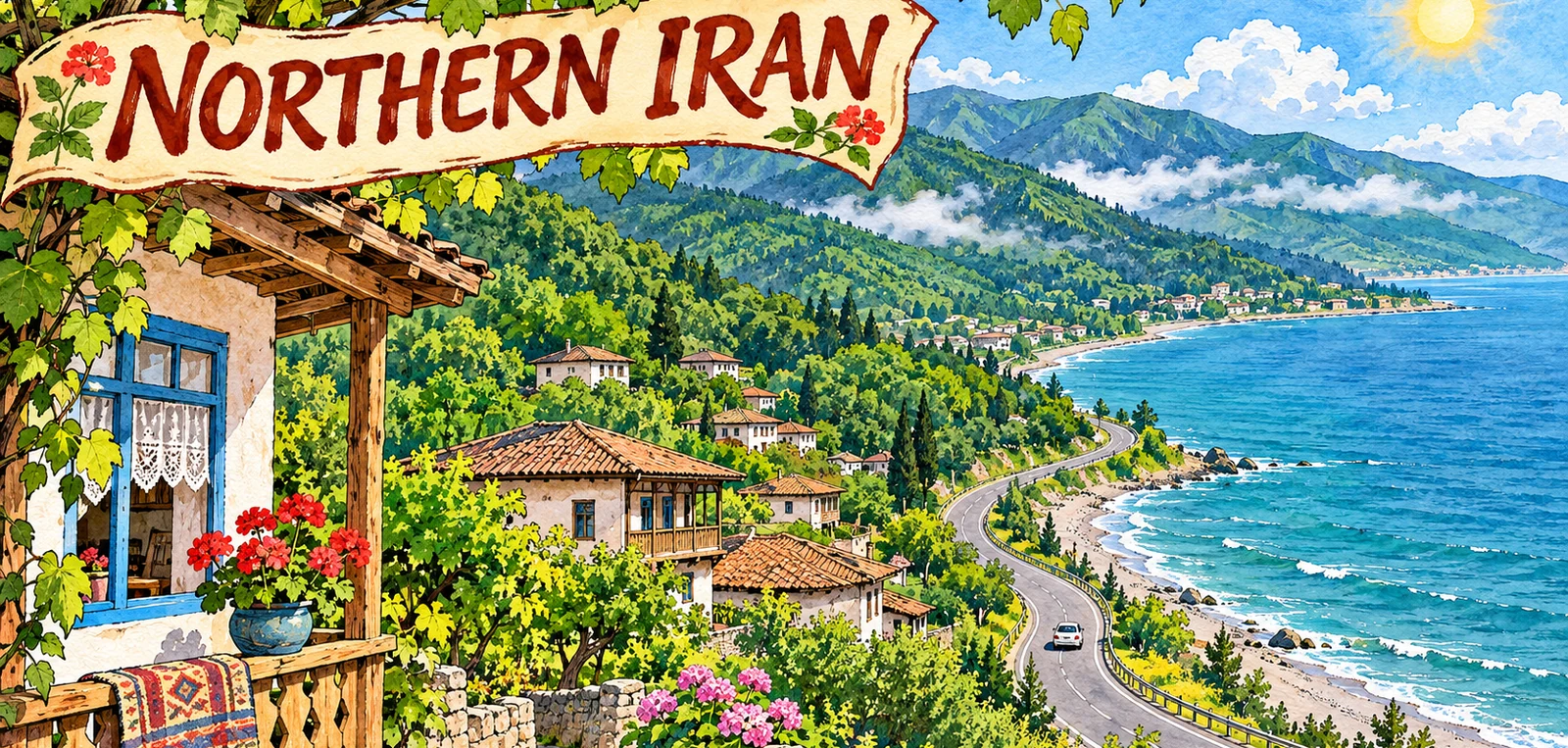
Shomal (شمال, shomâl, “north”) is what Iranians call the green strip of land between the Caspian Sea and the Alborz mountains: the provinces of Gilan, Mazandaran and Golestan. It is Iran’s wettest and most forested region, known for rice paddies, tea gardens, beaches and fish dishes, and it is the most popular weekend escape for people from Tehran.

What “Shomal” means in Iran
شمال simply means “north” in Persian, and you will hear it in compass directions too. But when an Iranian says رفتیم شمال (Raftim shomâl, “We went up north”) or بریم شمال؟ (Berim shomâl? “Shall we go north?”), they almost always mean the Caspian coast, not any northern place in general.
Searchers spell the word in many ways: shomal, shamal, shumal, shimal or the Turkish-style şomal. The Persian pronunciation is shomâl, with a short o and a long â. “Shamal” is closer to the Arabic pronunciation of the same word. A person from the region is a شمالی (shomâli, “northerner”), and the same word is used as an adjective: غذای شمالی (ghazâ-ye shomâli, “northern food”).
| Persian | Pronunciation | English |
|---|---|---|
| شمال | shomâl | north; the Caspian region |
| شمالی | shomâli | northern; a northerner |
| دریای خزر | daryâ-ye khazar | the Caspian Sea |
| دریای مازندران | daryâ-ye mâzandarân | the Caspian Sea (another Persian name) |
| جنگل | jangal | forest |
| شالیزار | shâlizâr | rice paddy |
| ویلا | vilâ | villa, holiday house |
| ساحل | sâhel | beach, shore |
Where is Shomal? The three Caspian provinces
Northern Iran in this sense is a fairly narrow lowland. The Caspian Sea lies to the north, and the Alborz range rises steeply to the south, which traps moisture from the sea and makes the region far greener than the Iranian plateau. The Caspian shore is below ocean level, at roughly 28 meters below sea level, so you drive down a long way from Tehran to reach it.
| Province | Persian | Capital | Known for |
|---|---|---|---|
| Gilan | گیلان (Gilân) | Rasht رشت | rice, tea around Lahijan, Anzali Lagoon, Masuleh village, rich cuisine |
| Mazandaran | مازندران (Mâzandarân) | Sari ساری | the longest stretch of coast, beach towns such as Ramsar, Chalus, Nowshahr and Babolsar, citrus orchards |
| Golestan | گلستان (Golestân) | Gorgan گرگان | Golestan National Park, Turkmen Sahra plains, Gonbad-e Qabus tower |
In everyday speech, “Shomal” usually means Gilan and Mazandaran. Golestan, at the eastern end, is often included, especially its forested western part around Gorgan.
Main cities and towns of northern Iran
- Rasht (رشت): the largest city of Gilan, famous for its food markets. UNESCO named it a Creative City of Gastronomy in 2015.
- Bandar Anzali (بندر انزلی): a Caspian port next to the Anzali Lagoon, a large wetland known for water lilies and birds.
- Lahijan (لاهیجان): the center of Iranian tea growing, with hillside tea gardens.
- Masuleh (ماسوله): a mountain village near Fuman whose houses are built so steeply up the slope that the roofs serve as the streets and courtyards for the houses above.
- Ramsar, Tonekabon, Chalus and Nowshahr: resort towns on the western Mazandaran coast, where the mountains come closest to the sea.
- Amol, Babol and Sari: the larger inland cities of Mazandaran.
- Gorgan and Gonbad-e Kavus: the main cities of Golestan.
Nature: forests, sea and mountains
The northern slopes of the Alborz are covered by the Hyrcanian forests (جنگلهای هیرکانی, jangal-hâ-ye hirkâni), an ancient broadleaf forest that UNESCO inscribed as a World Natural Heritage site in 2019. Between forest and sea lie rice paddies, citrus orchards and small villages. Rivers run fast from the mountains, and fog and rain are common for much of the year.

Gilan and western Mazandaran get the most rain in Iran, while the east of Golestan is drier and opens onto steppe. Golestan National Park, on the border between Golestan and North Khorasan, is Iran’s oldest national park.
The most famous sights of the north
Chalus Road
The Karaj to Chalus road (جاده چالوس, jâdde-ye Châlus) crosses the Alborz through tunnels, river valleys and forest. Many Iranians consider it the most scenic drive in the country, and it is also the slowest route north on busy weekends.

Dizin ski resort
Dizin, reached from the Chalus road, is one of Iran’s main ski resorts and among the highest in the region. In winter, many Tehranis combine a ski weekend with a trip down to the coast.

Dohezar and Sehezar
Dohezar (دوهزار, “two thousand”) and Sehezar (سههزار, “three thousand”) are two forested valleys that climb from Tonekabon into the mountains. Their roads are known for thick forest, fog, rivers and cool summer air.
Rudkhan Castle
Rudkhan Castle (قلعه رودخان, ghal’e-ye Rudkhân), near Fuman in Gilan, is a brick and stone fortress on a forested ridge. Its present walls are medieval, and some historians think it stands on older, possibly Sasanian, foundations. Visitors climb a long stepped path through the forest to reach it, and the castle covers about 2.6 hectares.

Waterfalls
The forests hide many small waterfalls. One is Rango waterfall, a cascade about 7 meters high surrounded by dense trees and plants.

Masuleh, Anzali Lagoon and Gonbad-e Qabus
Masuleh is the classic postcard village of Gilan. Anzali Lagoon is best seen by boat. Far to the east, the brick tower of Gonbad-e Qabus, built in the early 11th century, is a UNESCO World Heritage site and one of the tallest brick towers in the world.
Food of Shomal
Northern cooking is very different from the food of central Iran. It uses fresh herbs, garlic, sour flavors, rice and fish. Many Iranians plan a trip north partly around the food. Here are dishes you will hear about:
| Persian | Pronunciation | What it is |
|---|---|---|
| میرزا قاسمی | mirzâ ghâsemi | smoked eggplant mashed with garlic, tomato and egg |
| باقالی قاتق | bâghâli ghâtogh | fava beans with dill, garlic and egg |
| ترشتره | torsh-tare | a sour herb stew |
| کالکباب | kâl-kabâb | eggplant mixed with walnuts and sour pomegranate |
| زیتون پرورده | zeytun parvarde | olives marinated with walnuts, pomegranate and herbs |
| ماهی سفید | mâhi sefid | Caspian white fish, often fried or smoked |
| کته | kate | simple boiled rice, the everyday rice of the north |
| کلوچه | koluche | a filled cookie, famous from Fuman and Lahijan |
For more food words, see Persian restaurant vocabulary and seafood and fish names in Persian.
People and languages
Persian is understood everywhere, but many people in the north also speak regional languages: Gilaki (گیلکی) in Gilan, Mazandarani (مازندرانی, also called Tabari) in Mazandaran, Talysh in western Gilan, and Turkmen in parts of Golestan. If you learn standard Persian, you will be understood throughout Shomal, though local accents and words take time to follow.
Climate and the best time to visit
The Caspian coast has a humid, mild climate. Summers are warm and sticky rather than dry and hot, and winters on the coast are mild, while snow falls in the mountains above. Rain is possible in every season, and autumn is especially wet in Gilan.
- Late spring (May and June): green, fresh and less humid. A good time for forests and villages.
- Summer (July and August): the beach season, but also the most humid and crowded weeks.
- Early autumn (September and October): warm sea, fewer crowds and the start of autumn colors in the forest.
- Winter: quiet on the coast, with skiing in the Alborz.
The busiest times are the Nowruz holidays in late March and early April, summer school holidays and long weekends. The Persian calendar and Nowruz dates will help you see when Iranian holidays fall.
How to get there from Tehran
Most visitors drive from Tehran. Because so many people travel north at the same time, roads can be extremely slow on the Iranian weekend (Thursday and Friday) and during holidays.

| Route | Persian | Goes to |
|---|---|---|
| Chalus Road | جاده چالوس | Karaj to Chalus, western Mazandaran |
| Haraz Road | جاده هراز | Tehran to Amol, central Mazandaran, passing near Mount Damavand |
| Firuzkuh Road | جاده فیروزکوه | Tehran to Qaemshahr and Sari, eastern Mazandaran |
| Qazvin to Rasht | قزوین – رشت | Gilan, by expressway through the Sefidrud valley |
| Heyran Pass | گردنه حیران | Ardabil to Astara, western Gilan |
| Mashhad to Gorgan | مشهد – گرگان | Golestan from the east |
There are also domestic flights to Rasht, Sari and Gorgan, and rail links to Mazandaran and Gilan. For phrases you will use on the road, read travel words and phrases in Persian and 21 essential Farsi phrases for Iran.
Check what you learned about Shomal and Iran’s Caspian north.
1. What does شمال (shomâl) literally mean?
2. Which three provinces make up Shomal?
3. What is the capital of Gilan?
4. What is میرزا قاسمی (mirzâ ghâsemi)?
5. How do you say ‘We went up north’ in Persian?
6. Which town is the center of Iranian tea growing?
7. When are the roads north usually most crowded?
Answer key with explanations
- C. North: شمال means north. Iranians also use it for the Caspian region.
- D. Gilan, Mazandaran and Golestan: Gilan, Mazandaran and Golestan lie between the Caspian Sea and the Alborz mountains.
- C. Rasht: Rasht is the capital of Gilan. Sari is the capital of Mazandaran and Gorgan of Golestan.
- A. A smoked eggplant dish with garlic, tomato and egg: Mirzâ ghâsemi is a northern dish of smoked eggplant, garlic, tomato and egg.
- D. رفتیم شمال: رفتیم شمال (Raftim shomâl) is what Iranians say after a trip to the Caspian coast.
- A. Lahijan: Lahijan in Gilan is known for its hillside tea gardens.
- D. During Nowruz and on long weekends: Many Tehranis travel north at the same time, especially during Nowruz and holidays.
Common questions
What is Shomal in Iran?
Shomal (شمال) means “north” in Persian. In Iran it refers to the Caspian coast: Gilan, Mazandaran and usually Golestan. It is a green, rainy region between the Caspian Sea and the Alborz mountains.
Is it Shomal or Shamal?
The Persian pronunciation is shomâl. “Shamal” is closer to how the word is said in Arabic. Both refer to the same word, which means “north”.
Which provinces are in northern Iran?
On the Caspian side, the three provinces are Gilan (capital Rasht), Mazandaran (capital Sari) and Golestan (capital Gorgan). Ardabil, North Khorasan and others are also in the north of the country, but Iranians do not usually call them Shomal.
When is the best time to visit Shomal?
Late spring and early autumn are the most pleasant. Summer is the beach season but humid and crowded. Avoid Nowruz and long weekends if you dislike traffic.
How far is Shomal from Tehran?
The nearest coastal towns are only a few hours’ drive from Tehran across the Alborz, but the time depends heavily on traffic. On holidays the same drive can take much longer.
Learn more about Iran and Persian: the Farsi language, the Persian script, the great civilization of Persia, Mount Damavand and top places to visit in Iran.
Learn Persian with our bestseller
Serious about Persian? Get all 30 of our Persian learning books for $149.00 (55% less than buying them one by one).
Free Persian Starter Kit (PDF)
The Persian alphabet chart and the 101 most common Persian words with pronunciation, in one printable PDF. You also get a one-time 15% code for any of our books.
We will email you new lessons and book news from Learn Persian Online. Unsubscribe any time.Want to learn Persian? Get the free Starter Pack
Get the 14-page printable Starter Pack (all 32 letters, a 7-day reading plan, 100 core words and 20 survival phrases) and a short 5-email course. Free.
by: Reza about (category: Blog)

Reza is an experienced Persian instructor who has been tutoring students since 2008. He is the founder of Learn Persian Online, a tutoring company that has helped many students learn Persian, this beautiful language. He works with students individually and in group settings, he tutors both live and online Persian courses. Reza provides an individualized custom learning plan and the personalized attention that makes a difference in how people view Persian learning process.


What people say about "Shomal, Iran: A Guide to Northern Iran and the Caspian Coast"?
No one replied yet.