Cyrus the Great: Life, Family, Empire and Tomb
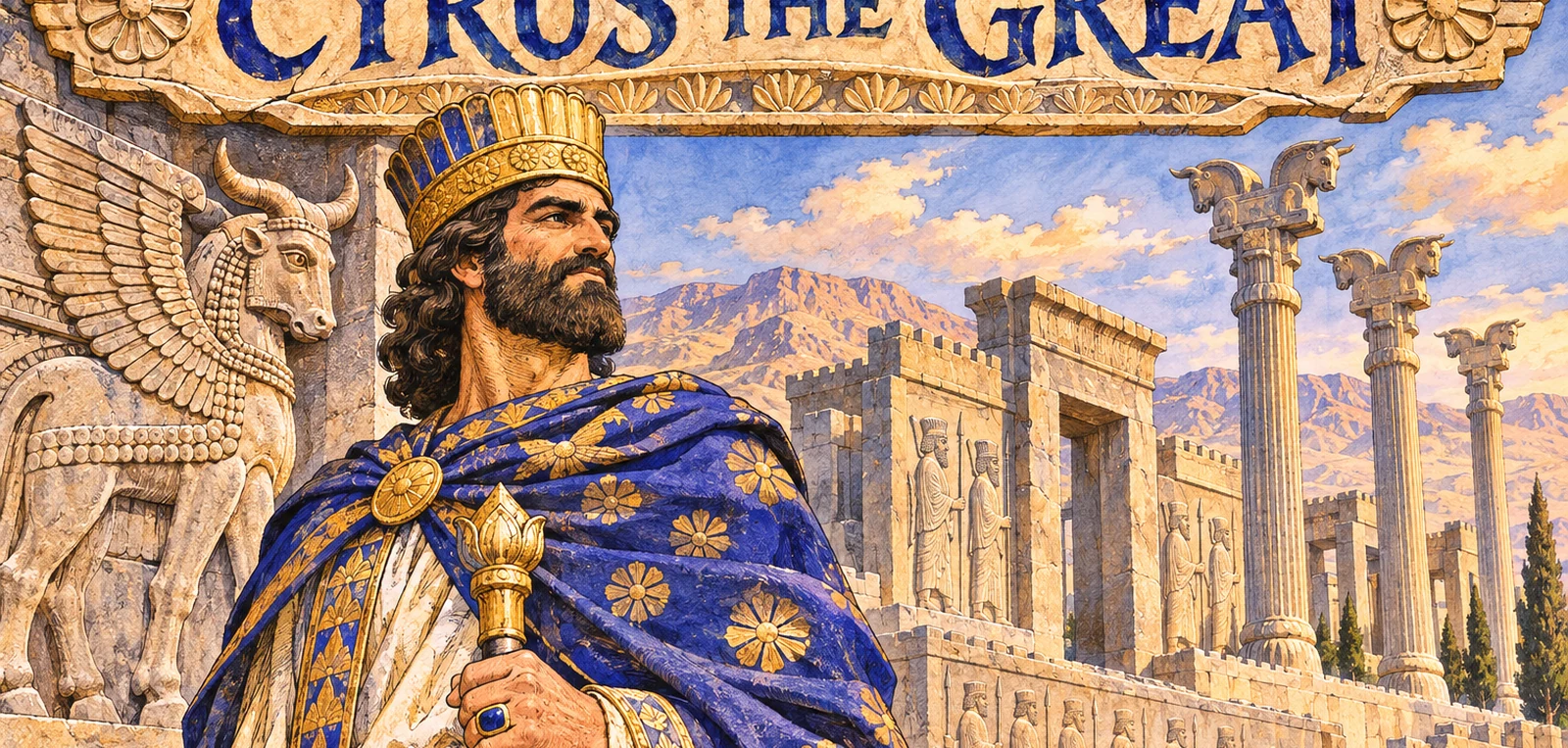
Cyrus the Great (کوروش بزرگ, Kurosh-e Bozorg), also called Cyrus II, founded the Achaemenid Persian Empire. He ruled from about 559 to 530 BC, conquered Media, Lydia and Babylon, and created the largest empire the world had seen up to that time. His tomb stands at Pasargadae in Fars province, Iran.

Cyrus the Great at a glance
| Fact | Details |
|---|---|
| Name in Persian | کوروش بزرگ (Kurosh-e Bozorg); Old Persian Kuruš |
| Other names | Cyrus II; in French Cyrus le Grand; in Hebrew Koresh |
| Dynasty | Achaemenid هخامنشی (Hakhâmaneshi) |
| Reign | about 559 to 530 BC |
| Homeland | Anshan and Persis (Pârs), today’s Fars province |
| Capital he built | Pasargadae پاسارگاد (Pâsârgâd) |
| Father and mother | Cambyses I, king of Anshan; Mandane (according to Herodotus, a daughter of the Median king Astyages) |
| Wife | Cassandane, from the Achaemenid family |
| Successor | his son Cambyses II |
| Death | 530 BC, on a campaign in Central Asia |
Who was Cyrus the Great? (simple version for kids)
About 2,500 years ago, Cyrus was the king of a small Persian kingdom in what is now southern Iran. He united the Persians and the Medes, then won wars against powerful kingdoms to the west and the east. His empire stretched from the Aegean Sea to Central Asia.
Cyrus is remembered because he often treated defeated kings and peoples mildly. He let people keep their gods and customs, and after he took Babylon he allowed groups who had been taken there by force, including the Jews, to go home. Iranians still call him کوروش (Kurosh), and many Iranian boys are named after him.
Cyrus the Great’s family: sons, daughters and wife
Cyrus’s inscription on the Cyrus Cylinder calls him “son of Cambyses, great king, king of Anshan, grandson of Cyrus, great king, king of Anshan, descendant of Teispes.” His wife was Cassandane, who, according to Herodotus, was a Persian of the Achaemenid family. Herodotus says Cyrus mourned her deeply when she died.
| Child | What we know |
|---|---|
| Cambyses II (son) | Succeeded Cyrus in 530 BC, conquered Egypt in 525 BC and died in 522 BC on his way back. Ancient sources disagree on how he died. |
| Bardiya (son, Greek Smerdis) | According to the Behistun inscription of Darius I, he was secretly killed by Cambyses. |
| Atossa (daughter) | Later married Darius I and became the mother of Xerxes I. |
| Artystone (daughter) | Named by Herodotus as another daughter of Cyrus who married Darius I. |
Some ancient writers mention another daughter, but the sources are not consistent. After Bardiya and Cambyses died without sons, the throne passed to Darius I, a distant Achaemenid relative.

The rise and conquests of Cyrus
Defeating the Medes (around 550 BC)
The Persians were at first subject to the Medes. Around 550 BC Cyrus rebelled against the Median king Astyages and took the Median capital, Ecbatana (Hegmataneh, modern Hamadan). According to Herodotus, Cyrus did not harm Astyages and kept him at his court. Cyrus now ruled both Medes and Persians.
Lydia and King Croesus
Croesus, the wealthy king of Lydia in western Anatolia, crossed the Halys River (the border with the former Median lands) to attack. Cyrus pursued him back to his capital, Sardis, and took the city in the 540s BC. Greek sources say Croesus was spared and lived on at the Persian court. The Greek cities of Ionia on the Aegean coast then came under Persian rule.

The eastern campaigns
Cyrus then campaigned in the east, bringing lands such as Parthia, Bactria and Sogdiana under his rule. Few details of these wars survive, but by their end the empire reached into Central Asia.
The conquest of Babylon (539 BC)
In 539 BC Cyrus defeated the Babylonian army and entered Babylon, ending the rule of King Nabonidus. Babylonian texts say the city was taken with little fighting. Cyrus presented himself as a legitimate king chosen by Marduk, the chief god of Babylon. He let deported peoples return to their homelands and restore their temples. In the Hebrew Bible, the Book of Isaiah calls Cyrus the Lord’s “anointed”, and the Book of Ezra records his decree allowing the Jews to return to Jerusalem.
Death in 530 BC
Cyrus died in 530 BC while campaigning in Central Asia. Herodotus says he was killed fighting the Massagetae, led by Queen Tomyris, but other Greek writers give different accounts. He was buried at Pasargadae.

The Cyrus Cylinder
The Cyrus Cylinder (استوانه کوروش, ostovâne-ye Kurosh) is a clay cylinder inscribed in Babylonian (Akkadian) cuneiform. It was written after the conquest of Babylon in 539 BC and was buried in the foundations of a wall in the city. It describes Cyrus as chosen by Marduk, criticizes Nabonidus, and says Cyrus returned the images of gods to their temples and let people return to their settlements.
The main part was found in 1879 by Hormuzd Rassam during excavations at Babylon for the British Museum, where it is kept today. In the 1970s, a fragment in the Babylonian Collection of Yale University was identified as part of the same text. In 1971 Iran presented a replica to the United Nations, and the replica is on display at UN headquarters in New York.
The cylinder is often called the first charter of human rights. Many historians see it instead as a traditional Mesopotamian royal inscription, though one that shows Cyrus’s policy of respecting local religions. Both views are widely discussed.

How Cyrus was remembered
Many ancient peoples remembered Cyrus well. Herodotus says the Persians called him “father.” The Greek writer Xenophon wrote the Cyropaedia (“The Education of Cyrus”), a partly fictional portrait of Cyrus as a model ruler. For the Jews, he was the king who ended the Babylonian exile. In modern Iran, Cyrus is a national symbol, and his name appears in Persian literature and everyday life.

The land of Cyrus the Great
Cyrus came from Persis (پارس, Pârs), the region in southwestern Iran that gave Persia and the Persian language their names. Today it is Fars province, whose capital is Shiraz. The heart of his kingdom was the plain of Pasargadae, where he built his capital, palaces and gardens. His successors later built Persepolis about 87 km away.
The tomb of Cyrus the Great
The tomb (آرامگاه کوروش, ârâmgâh-e Kurosh) stands about a kilometer southwest of the palaces of Pasargadae. It is a small stone chamber with a gabled roof on top of a six-stepped stone platform, about 11 meters high in total. The stones were held together with metal clamps, not mortar. Greek historians of Alexander the Great say Alexander visited the tomb and ordered it restored after it had been robbed.
In the Islamic period, local people called the tomb مشهد مادر سلیمان (Mashhad-e Mâdar-e Soleymân, “shrine of the mother of Solomon”), which helped protect it. European travelers identified it as the tomb of Cyrus in the early 19th century. The tomb and the rest of Pasargadae were inscribed on the UNESCO World Heritage List in 2004.


Monuments and palaces of Cyrus at Pasargadae
Most buildings from Cyrus’s reign are at Pasargadae, which he founded as his capital. The site includes a gatehouse (the Gate Palace) with a relief of a four-winged figure, an audience palace with tall stone columns, a private palace, a large royal garden laid out with stone water channels, a stone tower known as زندان سلیمان (Zendân-e Soleymân, “Prison of Solomon”), and a fortified platform called تل تخت (Tall-e Takht). Some of the palaces carry short trilingual inscriptions in Old Persian, Elamite and Babylonian. The later palaces at Persepolis (تخت جمشید, Takht-e Jamshid) were built by Darius I and his successors, not by Cyrus.
Read the full guide to Pasargadae and its monuments, and see Persepolis and the great civilization of Persia.


Persian words related to Cyrus
| Persian | Pronunciation | English |
|---|---|---|
| کوروش بزرگ | Kurosh-e Bozorg | Cyrus the Great |
| هخامنشیان | Hakhâmaneshiyân | the Achaemenids |
| پادشاه | pâdeshâh | king |
| شاهنشاهی | shâhanshâhi | empire, imperial rule |
| استوانه کوروش | ostovâne-ye Kurosh | the Cyrus Cylinder |
| آرامگاه | ârâmgâh | tomb, resting place |
To read names like these yourself, start with the Persian alphabet, or try writing your own name in Persian.
Check what you learned about Cyrus the Great.
1. Which empire did Cyrus the Great found?
2. How do you say ‘Cyrus the Great’ in Persian?
3. Which son succeeded Cyrus as king?
4. In what year did Cyrus take Babylon?
5. Where is the Cyrus Cylinder kept today?
6. Where is Cyrus the Great buried?
7. Which daughter of Cyrus became the mother of Xerxes I?
Answer key with explanations
- D. The Achaemenid Empire: Cyrus II founded the Achaemenid Persian Empire in the 6th century BC.
- D. کوروش بزرگ: Kurosh-e Bozorg, with the ezâfe -e linking the name and the adjective.
- C. Cambyses II: Cambyses II became king in 530 BC and later conquered Egypt.
- D. 539 BC: Cyrus entered Babylon in 539 BC. The Cyrus Cylinder was written after this.
- D. The British Museum: The original is in the British Museum. A replica is on display at the UN in New York.
- A. Pasargadae: His stone tomb stands at Pasargadae in Fars province.
- B. Atossa: Atossa married Darius I. Cassandane was Cyrus’s wife, Mandane his mother, and Tomyris a Massagetae queen.
Common questions
Who were Cyrus the Great’s sons?
Cyrus had two sons, Cambyses II and Bardiya (Smerdis in Greek). Cambyses II became king after Cyrus in 530 BC and conquered Egypt. Bardiya, according to Darius I, was secretly killed by Cambyses.
Did Cyrus the Great have daughters?
Yes. Atossa and Artystone are named in ancient sources, and both married Darius I. Atossa was the mother of Xerxes I.
How tall was Cyrus the Great?
No reliable ancient source records his height. Statues and pictures of Cyrus today are modern imaginings, not portraits.
What is Cyrus the Great known for?
He founded the Achaemenid Empire, conquered Media, Lydia and Babylon, allowed deported peoples to return home, and is remembered for tolerance toward local religions. The Cyrus Cylinder records his policies in Babylon.
Where is Cyrus the Great buried?
At Pasargadae, in Fars province in southern Iran. His stone tomb still stands there.
Test more Iran knowledge with the Iran quiz.
More in our Iran section: The Achaemenid Empire, with separate pages on Cyrus taking Babylon, the Cyrus Cylinder and the death of Cyrus.
Learn Persian with our bestseller
Serious about Persian? Get all 30 of our Persian learning books for $149.00 (55% less than buying them one by one).
Free Persian Starter Kit (PDF)
The Persian alphabet chart and the 101 most common Persian words with pronunciation, in one printable PDF. You also get a one-time 15% code for any of our books.
We will email you new lessons and book news from Learn Persian Online. Unsubscribe any time.Free Persian Starter Pack: Alphabet + 100 Core Words
Get the 14-page printable Starter Pack (all 32 letters, a 7-day reading plan, 100 core words and 20 survival phrases) and a short 5-email course. Free.
by: Reza about (category: Blog)

Reza is an experienced Persian instructor who has been tutoring students since 2008. He is the founder of Learn Persian Online, a tutoring company that has helped many students learn Persian, this beautiful language. He works with students individually and in group settings, he tutors both live and online Persian courses. Reza provides an individualized custom learning plan and the personalized attention that makes a difference in how people view Persian learning process.


What people say about "Cyrus the Great: Life, Family, Empire and Tomb"?
No one replied yet.