Azadi Tower in Tehran: History, Architecture and Visiting
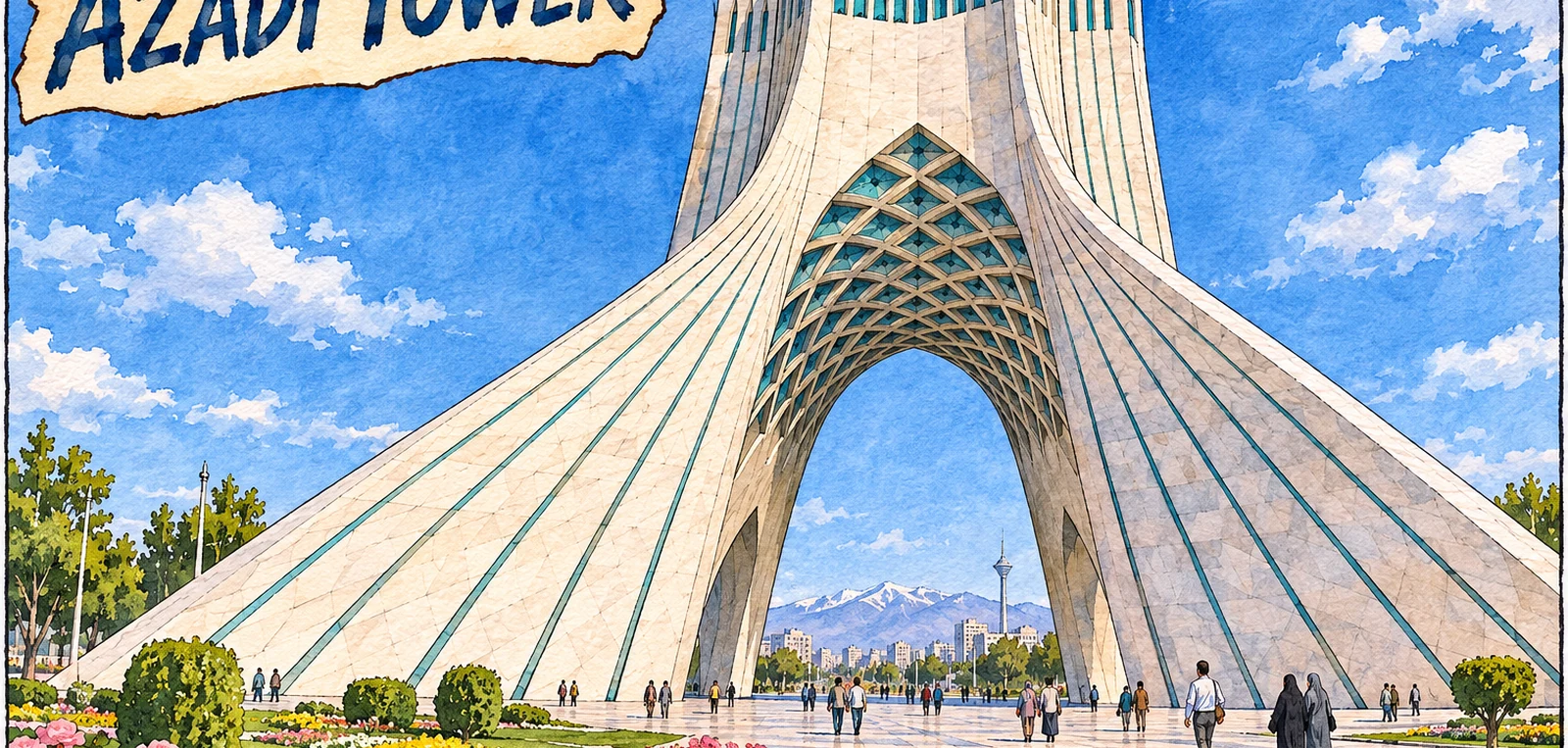
Azadi Tower (برج آزادی, Borj-e Âzâdi, “Freedom Tower”) is the white marble gateway monument in Azadi Square, at the western entrance of Tehran. Designed by architect Hossein Amanat and opened in October 1971 as the Shahyad Tower, it is about 45 meters tall and was renamed Azadi after the 1979 revolution. Its basement holds a museum and galleries.

Azadi Tower at a glance
| Fact | Details |
|---|---|
| Persian name | برج آزادی (Borj-e Âzâdi), “Freedom Tower” |
| Original name | شهیاد (Shahyâd), “memorial of the kings” |
| Architect | Hossein Amanat (حسین امانت) |
| Built | 1969 to 1971 (1348 to 1350 in the Iranian calendar) |
| Opened | October 1971, for the celebrations of 2,500 years of the Persian monarchy |
| Height | about 45 meters |
| Location | میدان آزادی (Meydân-e Âzâdi), western Tehran, near Mehrabad Airport |
| Metro | Meydan-e Azadi station, Tehran Metro Line 4 |
History of Azadi Tower
In the late 1960s, the Iranian government held a competition for a monument to mark the 2,500th anniversary of the Persian monarchy, which was celebrated in 1971. The winner was Hossein Amanat, then a young architect in his twenties. Construction started in 1969 and the tower was opened in October 1971 under the name Shahyad, short for Shahyad Aryamehr.
After the 1979 revolution, the tower and the square were renamed Azadi, “freedom.” Because the square is so large and central, it has since been the setting for many public gatherings and marches. Azadi Tower was the main symbol of Tehran for decades before the much taller Milad Tower was built, and many people still see it as the city’s signature landmark.

Azadi Tower architecture
Amanat combined pre-Islamic and Islamic Iranian forms in a modern structure. The large central arch recalls Sasanian vaults such as the Taq-e Kasra, while the pointed arch above it and the curved ribs inside follow Islamic architecture. The body of the tower is clad in thousands of blocks of white stone, each cut to its own shape so that the curved surfaces fit together, a very complex task for the time.
Inside, the ceilings are built of a ribbed lattice that reminds many visitors of the domes of Isfahan, such as the Sheikh Lotfollah Mosque on Naghsh-e Jahan Square. The top of the tower is crowned with turquoise tilework, a color long used on Iranian domes and tombs.

Inside Azadi Tower
One of the striking features of the interior is that the spaces are not closed off from one another. Openings in the floors and ceilings let you look up through several levels toward the top of the tower, and small windows connect the inside with the sky and the city. The upper floors, above the main arch, are reached by elevator and stairs.

The parts of Azadi Tower
The tower has an underground level with exhibition spaces and three upper floors. The basement sections below have changed over the years and are managed as a cultural center, so exhibits may differ when you visit.
Basement (museum level)
Iranology Hall
This hall introduces the provinces of Iran with a large relief model of the country, from the Caspian Sea in the north to the Persian Gulf and the Sea of Oman in the south, along with screens showing films about Iranian culture and handicrafts.

Ceremony Hall
A reception hall for official guests and events, decorated with Iranian motifs on the ceiling.

Ancestors Passage
A corridor near the entrance hall with showcases of historical objects and artworks, notable for its stone doors and low lighting.

Mirror Hall
A hall of display booths on themes such as cities, wildlife, industry and sport. Mirrors in the showcases make them look much larger than they are, which gives the hall its name.

Ethnic Gallery
A semicircular corridor with showcases of objects and handicrafts from Iran’s ethnic groups.

Bustan Gallery
The main art gallery of the tower, a quiet hall under a large skylight used for exhibitions and art workshops.

Library
A small library with books on Iranian history, architecture, language and literature in Persian, English and French.

Technology Corridor
A space for modern exhibits, which has included interactive screens about Iranian history and robots built by Iranian engineers.

Ancient Hall (main museum)
The main museum, directly under the tower, has showcases of historical objects and artworks and has hosted temporary exhibitions, such as Qajar jewelry from the Saadabad museums. The elevators and stairs to the upper floors start here, and a small shop sells handicrafts and souvenirs.

Multi-vision Hall and cinema
A deep underground auditorium is used for films, concerts, conferences and light shows. A smaller simulation cinema with moving seats was added later beside the Iranology Hall.


First floor
The first floor sits above the main arch and is mostly a transfer level between elevators. Its sloping walls have the small blue windows you can see from under the arch.

Second floor
The second floor is lit by a concrete dome and is the best place to see the tower’s ribbed interior. It is used to show historical photographs.

Third floor and roof
The top floor has tall, narrow openings inspired by traditional Iranian wind catchers, with views over western Tehran and, on clear days, the Alborz mountains. Above it rises the small turquoise-tiled dome that crowns the tower.

Azadi Square
Azadi Square (میدان آزادی) was designed together with the tower. It is one of the largest squares in Tehran, a huge oval of lawns, fountains and paths surrounded by heavy traffic. It is the main western gateway to the city: Mehrabad Airport and Tehran’s West Bus Terminal are close by. Azadi Stadium, Iran’s national football stadium, shares the name but is a separate site farther west.


Visiting Azadi Tower
- Take Tehran Metro Line 4 to Meydan-e Azadi station. See the Tehran Metro guide.
- Use the pedestrian underpasses to reach the tower; do not try to cross the traffic circle on foot.
- Evening is a good time to visit, when the tower is lit up.
- Check opening hours locally before you go, as the museum may close on some holidays.
Plan the rest of your trip with the best places to visit in Tehran and Golestan Palace.
Useful Persian words
| Persian | Pronunciation | English |
|---|---|---|
| برج | borj | tower |
| آزادی | âzâdi | freedom |
| میدان | meydân | square |
| موزه | muze | museum |
| طاق | tâgh | arch, vault |
Notice the ezâfe in برج آزادی (borj-e âzâdi, “tower of freedom”). Learn how it works in Ezafe in Persian.
Check what you learned about Azadi Tower.
1. What does برج آزادی (Borj-e Âzâdi) mean?
2. Who designed Azadi Tower?
3. What was the tower’s original name?
4. In which year did Azadi Tower open?
5. About how tall is Azadi Tower?
6. Which metro line serves Meydan-e Azadi station?
Answer key with explanations
- D. Freedom Tower: Borj means tower and âzâdi means freedom.
- A. Hossein Amanat: Hossein Amanat won the design competition in the late 1960s.
- C. Shahyad: It opened as the Shahyad Tower in 1971 and was renamed Azadi after 1979.
- C. 1971: It opened in October 1971 for the 2,500-year celebrations.
- B. 45 meters: Azadi Tower is about 45 meters tall. 435 meters is Milad Tower.
- A. Line 4: Meydan-e Azadi station is on Tehran Metro Line 4.
Common questions
Who designed Azadi Tower?
The Iranian architect Hossein Amanat, who won the design competition in the late 1960s when he was in his twenties.
When was Azadi Tower built?
It was built from 1969 to 1971 and opened in October 1971, during the celebrations of 2,500 years of the Persian monarchy.
Why was Azadi Tower called Shahyad?
Its original name, Shahyad, means “memorial of the kings,” because it was built for the monarchy’s 2,500-year celebrations. It was renamed Azadi (“freedom”) after the 1979 revolution.
How tall is Azadi Tower?
About 45 meters. It is much smaller than Milad Tower (435 meters), but it is older and was Tehran’s main symbol for decades.
Can you go inside Azadi Tower?
Yes. The basement museum and galleries are open to visitors, and the upper floors can be reached by elevator and stairs.
Learn Persian with our bestseller

Serious about Persian? Get all 30 of our Persian learning books for $149.00 (55% less than buying them one by one).
Free Persian Starter Kit (PDF)
The Persian alphabet chart and the 101 most common Persian words with pronunciation, in one printable PDF. You also get a one-time 15% code for any of our books.
We will email you new lessons and book news from Learn Persian Online. Unsubscribe any time.Free Persian Starter Pack: Alphabet + 100 Core Words
Get the 14-page printable Starter Pack (all 32 letters, a 7-day reading plan, 100 core words and 20 survival phrases) and a short 5-email course. Free.
by: Reza about (category: Blog)

Reza is an experienced Persian instructor who has been tutoring students since 2008. He is the founder of Learn Persian Online, a tutoring company that has helped many students learn Persian, this beautiful language. He works with students individually and in group settings, he tutors both live and online Persian courses. Reza provides an individualized custom learning plan and the personalized attention that makes a difference in how people view Persian learning process.


What people say about "Azadi Tower in Tehran: History, Architecture and Visiting"?
No one replied yet.