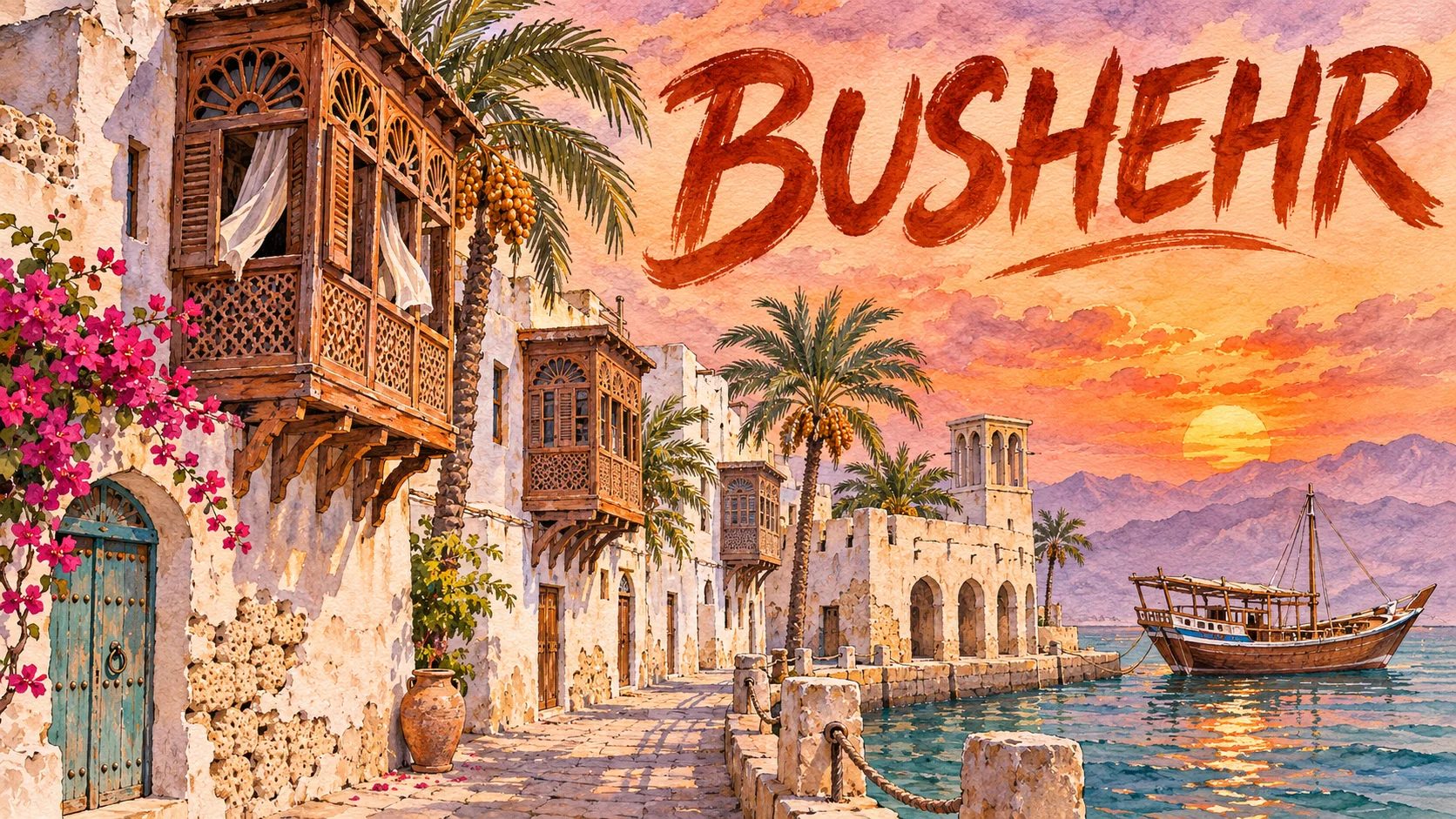
Bushehr is the capital of Bushehr province, a port city of about 220,000 people on a narrow peninsula on Iran’s Persian Gulf coast. From the 1730s until the early twentieth century it was Iran’s main seaport and the base of the British Residency in the Persian Gulf, and its old quarter of coral-stone houses with wooden balconies is one of the most distinctive historic townscapes on the Iranian coast.
| Persian name | بوشهر (Bushehr); in older English, Bushire |
|---|---|
| Province | Bushehr (capital) |
| Population | 223,504 (city, 2016 census, Statistical Centre of Iran) |
| Climate | Hot and humid for most of the year; mild winters |
| Languages heard | Persian with a local Bushehri dialect, Arabic |
| Distance | About 300 km west of Shiraz by road; about 1,200 km south of Tehran |
Elamite and Sasanian beginnings
The southern end of the Bushehr peninsula has been settled since the Elamite period. At Liyan, excavated by the French archaeologist Maurice Pézard in 1913, bricks inscribed by the Middle Elamite king Shilhak-Inshushinak in the twelfth century BCE record a temple, showing that the kings of Susa controlled this stretch of coast. In the Sasanian period the town of Rev-Ardashir, at modern Rishahr, south of the city, was a port and a bishopric of the Church of the East. Medieval geographers mention small ports on the peninsula, but the great harbours of the coast were elsewhere, at Siraf and later Hormuz.
Nader Shah’s naval base
Modern Bushehr was built by Nader Shah. In 1734 he chose the small fishing village on the peninsula as the base for a new Iranian navy, to be used against the Arab powers of the Persian Gulf, and the town was briefly called Bandar-e Naderiyeh. The navy did not survive him, but the port did. As Bandar Abbas declined after the fall of the Safavids, trade shifted to Bushehr, which was much closer to Shiraz and the centre of the country.


The British Residency
In 1763 Karim Khan Zand allowed the English East India Company to open a factory at Bushehr, and over the next century it became the seat of the British Political Resident in the Persian Gulf, the official who managed Britain’s treaties with the Arab rulers on the southern shore. Bushehr was in effect Iran’s window on the sea: most imports for Shiraz, Isfahan and Tehran came through it and up the steep caravan road over the Zagros passes.
British troops occupied the town twice. In 1856, during the Anglo-Persian War over Herat, a British expedition landed and held Bushehr until peace was made in 1857. In the First World War British forces again occupied it, in 1915, to secure the Gulf. Local resistance led by the Tangestani chiefs and by Ra’is Ali Delvari, who was killed in 1915, is remembered in Iran as an episode of national defence. The Residency moved to Bahrain in 1946.
The old town
The historic quarter at the northern tip of the peninsula, Bafeh-ye Ghadim (the “old fabric”), grew up in the eighteenth and nineteenth centuries as a dense maze of narrow lanes between tall merchants’ houses. They were built of porous stone from the shore, plastered white, with wooden balconies and screens, شناشیل (shenâshil), that catch the sea breeze while keeping out the sun. Windcatchers are rare here: in the humid air, cross-ventilation from the sea mattered more.
Several houses have been restored as museums and cultural centres, and the quarter also contains mosques, old water cisterns and a nineteenth-century Armenian church, a reminder of the merchant communities, Armenian, Indian, Jewish and European, that once worked here.
Music, mourning and literature
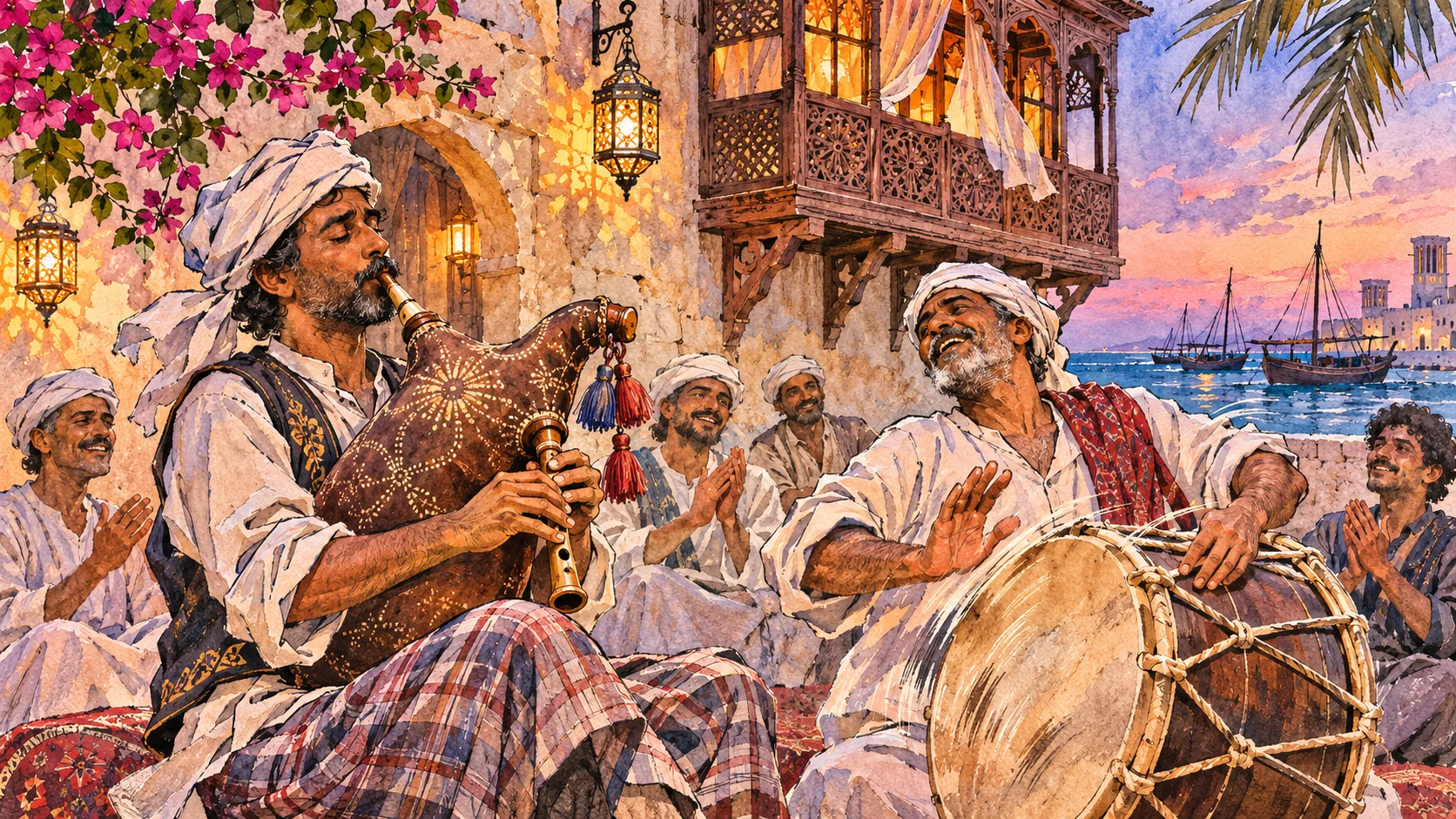
Bushehr has its own musical tradition, with strong African and Arab influences brought by sailors and by the descendants of enslaved East Africans. The نیانبان (ney-anbân), a bagpipe made from a goatskin bag, and the large dammam drums are its signature sounds. During Muharram, mourning processions with drums and cymbals (senj o dammam) are among the most striking in Iran. Musicians from Bushehr, such as the Lian ensemble, brought this music to national and international audiences from the 1990s.
The novelist Sadegh Chubak was born in Bushehr in 1916, and his novel Tangsir (1963), about a man from the Tangestan hinterland who takes revenge on the merchants who cheated him, is set in the town. It was later made into a well-known Iranian film.
Oil, gas and the nuclear plant
Today Bushehr province is at the centre of Iran’s energy industry. The giant offshore South Pars gas field, shared with Qatar, is developed from Asaluyeh, about 270 km to the south-east, and Kharg Island, Iran’s main crude oil terminal, lies off the coast to the north-west. South of the city stands the Bushehr nuclear power plant, begun by the German firm Kraftwerk Union in 1975, halted after the 1979 revolution and damaged in the Iran–Iraq War, then completed with Russian assistance and connected to the grid in 2011. Its role in Iran’s nuclear programme has been the subject of international debate.
Food on the Bushehr coast
The local cooking relies on fish, shrimp, dates and spice. Typical dishes are ghalieh mahi and ghalieh meygu, fish or shrimp stews with tamarind, coriander and fenugreek; dopiazeh, with plenty of onion; and the fish curries that show the old ties with India. For a broader introduction, see Persian food.
Getting there
Bushehr has an airport with flights from Tehran and other cities, and is about four hours by road from Shiraz, down through the Zagros. The seafront promenade is the place to be in the evening. October to April is the most comfortable time to visit. For opening hours, transport and safety, check current official information and your own government’s travel advice.
Persian words from this page
| بوشهر | Bushehr | Bushehr |
| خلیج فارس | Khalij-e Fârs | Persian Gulf |
| شناشیل | shenâshil | wooden balcony screen |
| نیانبان | ney-anbân | bagpipe |
| تنگسیر | Tangsir | man from Tangestan; title of Chubak’s novel |
| دریا | daryâ | sea |
| میگو | meygu | shrimp |
Common questions
Why is Bushehr historically important?
From the 1730s until the early twentieth century Bushehr was Iran’s main seaport and the base of the British Residency in the Persian Gulf. Most imports for Shiraz, Isfahan and Tehran came through it and up the caravan road over the Zagros.
Who founded the modern city of Bushehr?
Modern Bushehr was built by Nader Shah. In 1734 he chose the small fishing village on the peninsula as the base for a new Iranian navy, and the town was briefly called Bandar-e Naderiyeh. The navy did not survive him, but the port did.
What are shenâshil in Bushehr?
Shenâshil (شناشیل) are the wooden balconies and screens on the coral-stone houses of Bushehr’s old quarter. They catch the sea breeze while keeping out the sun; in the humid air, cross-ventilation mattered more than windcatchers.
What is the ney-anbân (نیانبان) of Bushehr music?
- A large drum
- A pair of cymbals
- A long-necked lute
- A bagpipe made from a goatskin bag
The page describes the ney-anbân as a bagpipe made from a goatskin bag, a signature sound of Bushehr music.
Which novelist born in Bushehr in 1916 wrote Tangsir?
- Ra’is Ali Delvari
- Sadegh Chubak
- Maurice Pézard
- Shilhak-Inshushinak
Sadegh Chubak was born in Bushehr in 1916, and his novel Tangsir (1963) is set in the town.
When was the Bushehr nuclear power plant connected to the grid?
- 1975
- 1979
- 2011
- 1946
Begun in 1975 and halted after 1979, it was completed with Russian assistance and connected to the grid in 2011.
Sources and further reading
- Encyclopaedia Iranica, “Bushehr” (Būšehr).
- Willem Floor, The Rise of the Gulf Arabs: The Politics of Trade on the Persian Gulf, 1747–1792, Mage, 2007.
- J. G. Lorimer, Gazetteer of the Persian Gulf, Oman and Central Arabia, Calcutta, 1908–1915.
- Sadegh Chubak, Tangsir, 1963.
- Statistical Centre of Iran, General Population and Housing Census 2016 (1395).
Want to learn Persian? Get the free Starter Pack
Get the 14-page printable Starter Pack (all 32 letters, a 7-day reading plan, 100 core words and 20 survival phrases) and a short 5-email course. Free.
More in Cities of Iran
- Tehran: Iran’s Capital
- Mashhad
- Isfahan
- Shiraz
- Tabriz
- Yazd
- Kashan
- Kerman
- Hamadan
- Qom
- Ahvaz
- Rasht
- Kermanshah
- Urmia
- Ardabil
- Zanjan
- Qazvin
- Sanandaj
- Khorramabad
- Bandar Abbas
- Bushehr
- Zahedan
- Birjand
- Gorgan
- Sari
- Semnan
- Arak
- Ilam
- Yasuj
- Shahr-e Kord
- Bojnurd
- Karaj
- Abadan and Khorramshahr
- Kish Island
- Qeshm Island
- Hormuz Island
- Masuleh
- Abyaneh
- Kandovan
- Bam
- Neyshabur (Nishapur)
- Shush (Susa) Today