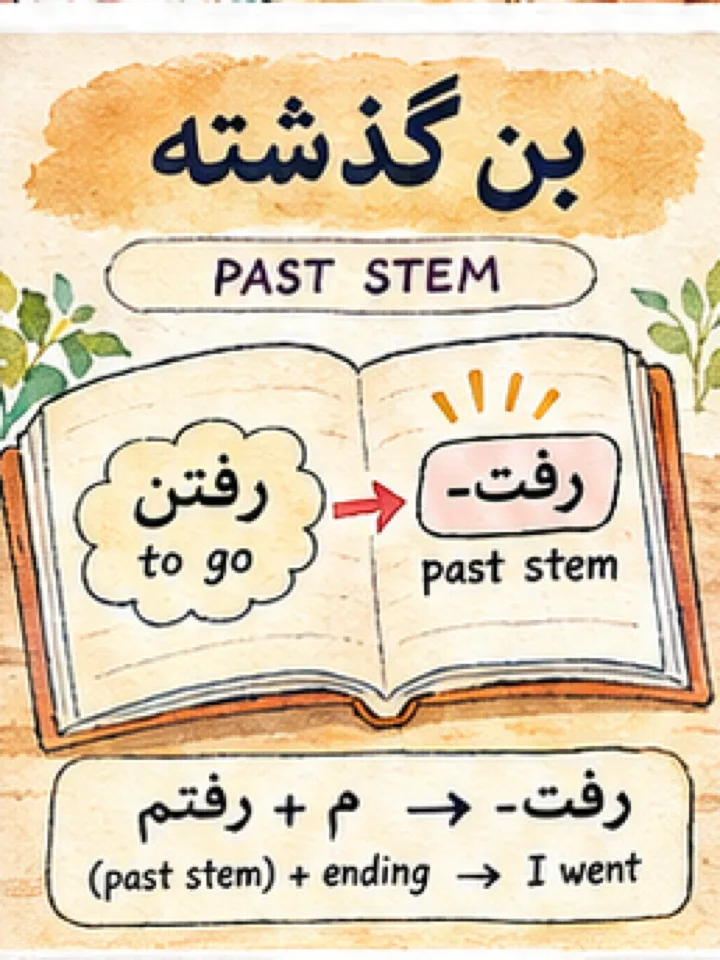
Learn how to form the Persian past stem by dropping the final ن of the infinitive, and how
Past Stem
This stem called “سِتاکِ گُذَشتِه” /setâke gozashte/ is used in shaping different forms of verb including simple past and
removing the letter “ن” at the end of infinitive.
| مَصدر | مَعنی | سِتاکِ گذشته |
| infinitive | meaning | Past Stem |
| دیدَن | To see | دید |
| گُفتَن | To say | گُفت |
| نِوِشتَن | To write | نِوِشت |
| رَفتَن | To go | رَفت |
| آمَدَن | To come | آمَد |
Learn how to form the Persian past stem by dropping the final ن of the infinitive, and how it builds the simple past, past continuous and perfect.
The past stem of Persian verbs
Every Persian verb has a past stem (in Persian ستاکِ گذشته, setâk-e gozashte, or بنِ ماضی, bon-e mâzi). Good news: unlike the present stem, it is completely regular. Take the infinitive and remove the final ن: رفتن (raftan) → رفت (raft). The past stem always ends in t or d.
Examples of past stems
| Infinitive → past stem | Pronunciation | Meaning |
|---|---|---|
| دیدن ← دید | /didan → did/ | to see → saw |
| گفتن ← گفت | /goftan → goft/ | to say → said |
| نوشتن ← نوشت | /neveshtan → nevesht/ | to write → wrote |
| رفتن ← رفت | /raftan → raft/ | to go → went |
| آمدن ← آمد | /âmadan → âmad/ | to come → came |
| خوردن ← خورد | /khordan → khord/ | to eat → ate |
| خریدن ← خرید | /kharidan → kharid/ | to buy → bought |
| خواندن ← خواند | /khândan → khând/ | to read → read |
| کردن ← کرد | /kardan → kard/ | to do → did |
| داشتن ← داشت | /dâshtan → dâsht/ | to have → had |
What the past stem builds
Almost every past and perfect tense is made from this stem. Here they are with رفتن:
| Form | Pronunciation | Tense |
|---|---|---|
| رفتم | /raftam/ | simple past: I went |
| رفت | /raft/ | simple past, he / she: no ending |
| نرفتم | /naraftam/ | negative: I didn't go |
| میرفتم | /miraftam/ | past continuous: I was going / I used to go |
| رفتهام | /rafte-am/ | present perfect: I have gone |
| رفته بودم | /rafte budam/ | past perfect: I had gone |
| خواهم رفت | /khâham raft/ | future (formal): I will go |
The past participle, used in the perfect tenses, is the past stem plus ـه (-e): رفته (rafte), دیده (dide), خورده (khorde).
Example sentences
| Persian | Pronunciation | English |
|---|---|---|
| دیروز به بازار رفتم. | /diruz be bâzâr raftam./ | I went to the bazaar yesterday. |
| او یک نامه نوشت. | /u yek nâme nevesht./ | He / She wrote a letter. |
| ما دیشب فیلم دیدیم. | /mâ dishab film didim./ | We watched a film last night. |
| چه گفتی؟ | /che gofti?/ | What did you say? |
| آنها دیر آمدند. | /ânhâ dir âmadand./ | They came late. |
| من شام نخوردم. | /man shâm nakhordam./ | I didn't eat dinner. |
| بچه که بودم، زیاد کتاب میخواندم. | /bache ke budam, ziyâd ketâb mikhândam./ | When I was a child, I used to read a lot. |
| این کتاب را خواندهام. | /in ketâb râ khânde-am./ | I have read this book. |
| فردا به تهران خواهم رفت. | /fardâ be tehrân khâham raft./ | I will go to Tehran tomorrow. (formal) |
Spoken Persian
Past forms change less in speech than present forms. The main changes: آمد (âmad) is said اومد (umad), "he / she came"; the plural endings become -in and -an: رفتین (raftin), رفتن (raftan), "they went" (which sounds like the infinitive). The present perfect drops its alef: رفتم can mean both "I went" and, said with stress on the last syllable, "I have gone". The formal future with خواستن is rare in speech; people use the simple present instead: فردا میرم (fardâ miram).
Common mistakes
- Using the present stem for the past: "I saw" is دیدم, not بینم.
- Adding an ending to the third person singular: "he went" is رفت, not رفتد.
- Using the infinitive as a verb: من رفتن does not mean "I went".
- Putting the future helper after the stem. Write خواهم رفت, with the helper first.
- Previous: adverbs with tanvin (lesson 17)
- Next: past verb endings (lesson 19)
- The Persian present stem (lesson 11)
Practice
-
What is the past stem of {{خوابیدن}}? خوابیدن
Show answer
khâbid خوابید
-
Say "I bought".
Show answer
kharidam خریدم
-
Say "he / she said".
Show answer
goft گفت
-
Make negative: {{دیدم}} دیدم
Show answer
nadidam, "I didn't see" ندیدم
-
Form the past participle of {{نوشتن}}. نوشتن
Show answer
nevesht + e = neveshte نوشته
See all the lessons in this series on the Persian grammar page.


Take this lesson further

Study with the book
Farsi Grammar in Use: For Beginners
This free lesson is part of Persian grammar lessons. The book puts the whole series in one printable PDF you can study offline.
Serious about Persian? Get all 30 of our Persian learning books for $149.00 (55% less than buying them one by one).
Free Persian Starter Kit (PDF)
The Persian alphabet chart and the 101 most common Persian words with pronunciation, in one printable PDF. You also get a one-time 15% code for any of our books.
We will email you new lessons and book news from Learn Persian Online. Unsubscribe any time.Free: Persian Alphabet + 100 Core Words (PDF)
Get the 14-page printable Starter Pack (all 32 letters, a 7-day reading plan, 100 core words and 20 survival phrases) and a short 5-email course. Free.