Learn when Persian uses the object marker را (râ) after a definite direct object, when it
Object Marker
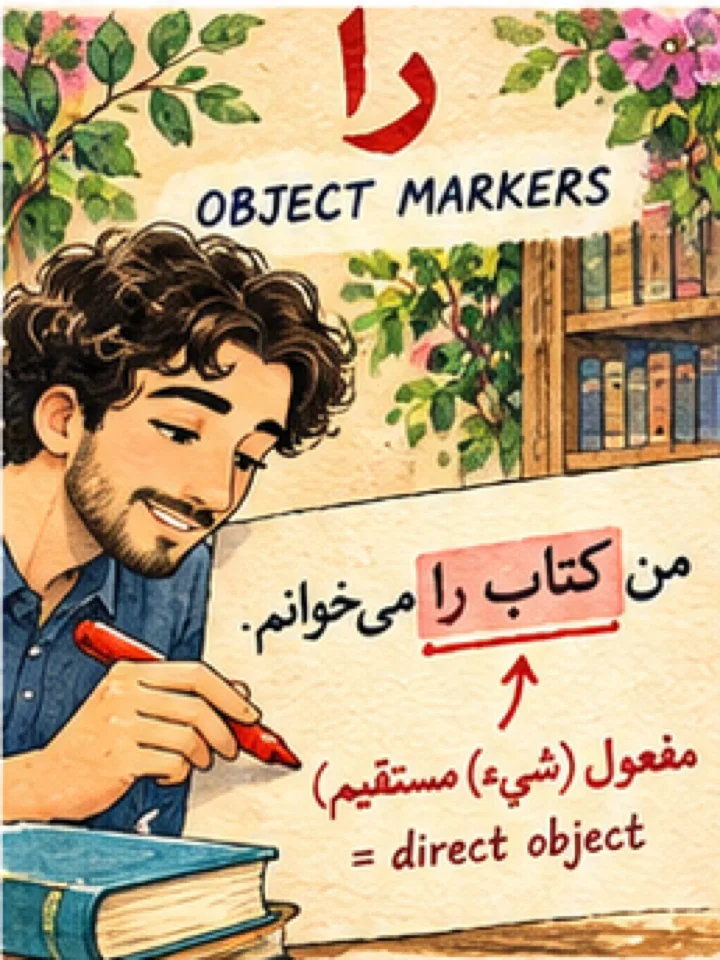
“را” /râ/ is always used after objects. Therefore, it’s an object marker.
| Persian | Pronunciation | English |
| .این کِتاب را خواندَم | /in ketâb râ khândam/ | I read this book. |
| .ما این قَهوِه را نِمی خُوریم | /mâ in ghahve râ nemikhordim/ | We don’t drink this coffee. |
| .لطفاً میز را بیاور | /lotfan miz râ biyâvar/ | Please bring the table. |
| .مَن او را دوست دارَم | /man u râ dust dâram/ | I like (love) her/him. |
Exercise: write with “را” .
1. من این کتاب دوست دارم.
2. او این درس نمی خواند.
3. تو قهوه دوست داری.
4. شما کتاب آوردی.
5. آنها صبحانه با چای می خورند.
Learn when Persian uses the object marker را (râ) after a definite direct object, when it is left out, and how it becomes -o in spoken Persian.
The object marker râ
Persian marks a specific direct object with the small word را (râ), placed right after it. English has nothing similar; word order and "the" do the job. Compare کتاب میخوانم (ketâb mikhânam), "I read books" (books in general), with کتاب را میخوانم (ketâb râ mikhânam), "I'm reading the book" (a book we both know about).
When to use râ
- With a definite direct object, one the listener can identify: در را ببند (dar râ beband), "Close the door".
- With این and آن: این فیلم را دیدم (in film râ didam), "I saw this film".
- With names and pronouns: سارا را دیدم (sârâ râ didam), "I saw Sara"; او را میشناسم (u râ mishenâsam), "I know him / her".
- With nouns that have a possessive: کتابت را آوردی؟ (ketâbat râ âvardi?), "Did you bring your book?"
When not to use râ
- With general or non-specific objects: چای دوست دارم (chây dust dâram), "I like tea" (tea in general).
- After the subject: را never marks who does the action.
- With objects introduced by a preposition: به سارا گفتم (be sârâ goftam), "I told Sara", has no را.
- With verbs that take no object, like رفتن or آمدن.
Where râ goes
را comes after the whole object phrase, including adjectives and possessors, just before the rest of the sentence: کتابِ جدیدِ من را دیدی؟ (ketâb-e jadid-e man râ didi?), "Did you see my new book?" With من the formal written form is often مرا (marâ), "me"; with تو it is تو را or تورا (torâ).
The page's examples, explained
| Persian | Pronunciation | English |
|---|---|---|
| این کتاب را خواندم. | /in ketâb râ khândam./ | I read this book. ("this" makes it definite) |
| ما این قهوه را نمیخوریم. | /mâ in ghahve râ nemikhorim./ | We don't drink this coffee. |
| لطفاً میز را بیاور. | /lotfan miz râ biyâvar./ | Please bring the table. |
| من او را دوست دارم. | /man u râ dust dâram./ | I like (love) him / her. (pronoun object) |
More examples
| Persian | Pronunciation | English |
|---|---|---|
| این فیلم را دیدم. | /in film râ didam./ | I saw this film. |
| نامه را نوشتم. | /nâme râ neveshtam./ | I wrote the letter. |
| در را ببند. | /dar râ beband./ | Close the door. |
| مرا ببخشید. | /marâ bebakhshid./ | Excuse me. / Forgive me. |
| پدرت را میشناسم. | /pedarat râ mishenâsam./ | I know your father. |
| کلید را کجا گذاشتی؟ | /kelid râ kojâ gozâshti?/ | Where did you put the key? |
| من کتاب میخوانم. | /man ketâb mikhânam./ | I read books. (general, no râ) |
| غذایت را بخور. | /ghazâyat râ bokhor./ | Eat your food. |
Spoken Persian
In conversation را turns into -o after a consonant and -ro after a vowel, and it is written that way in informal texts: این فیلمو دیدم (in filmo didam), "I saw this film"; غذاتو بخور (ghazâto bokhor), "Eat your food"; چایی رو بیار (châyi ro biyâr), "Bring the tea". من را becomes منو (mano).
Common mistakes
- Using را with every object. Generic objects do not take it: قهوه دوست دارم, "I like coffee".
- Leaving it out with a definite object: این کتاب دوست دارم sounds wrong; say این کتاب را دوست دارم.
- Putting را before the adjective: کتاب را جدید is wrong; say کتابِ جدید را.
- Using را for an indirect object: "I gave Ali the book" is کتاب را به علی دادم.
Do the exercise on this page, then check it on the answer page.
- Lesson 16 answers, explained
- Previous: short forms of "to be" (lesson 15)
- Next: adverbs with tanvin (lesson 17)
Practice
-
Add râ if needed: {{آن ماشین دیدم.}} آن ماشین دیدم.
Show answer
ân mâshin râ didam: "I saw that car." آن ماشین را دیدم.
-
Does {{نان میخرم}} ("I buy bread") need râ? نان میخرم
Show answer
No. The bread is general, not a specific loaf.
-
Translate: "I know Reza."
Show answer
rezâ râ mishenâsam. رضا را میشناسم.
-
How do you say {{در را ببند}} in spoken Persian? در را ببند
Show answer
daro beband درو ببند
-
Where does râ go in "my new book" as an object?
Show answer
After the whole phrase: ketâb-e jadid-e man râ کتابِ جدیدِ من را
See all the lessons in this series on the Persian grammar page.
Answer key
Do the exercises above first, then check your answers here.
تمرین: 1. من این کتاب را دوست دارم. 2. او این درس را نمی خواند. 3. تو قهوه را دوست نداری. 4. آنها صبحانه را با چای می خورند.
All five answers to the lesson 16 exercise on the Persian object marker را, each explained and translated, with corrections and extra practice.
Lesson 16 exercise: the answers explained
The task is to add را (râ) to each sentence. را goes right after a direct object that is specific, for example one with این ("this") or one the speaker has in mind.
| Answer | Pronunciation | English |
|---|---|---|
| ۱. من این کتاب را دوست دارم. | /1. man in ketâb râ dust dâram./ | I like this book. |
| ۲. او این درس را نمیخواند. | /2. u in dars râ nemikhânad./ | He / She doesn't study this lesson. |
| ۳. تو قهوه را دوست داری. | /3. to ghahve râ dust dâri./ | You like the coffee. |
| ۴. شما کتاب را آوردید. | /4. shomâ ketâb râ âvardid./ | You brought the book. |
| ۵. آنها صبحانه را با چای میخورند. | /5. ânhâ sobhâne râ bâ chây mikhorand./ | They have their breakfast with tea. |
Why each answer is right
- 1. این کتاب, "this book", is clearly specific, so it needs را. Note that دوست داشتن is a compound verb: را goes after the object, before دوست.
- 2. Again این makes the object specific. را sits before the negative verb نمیخواند.
- 3. With را the sentence means "you like the coffee" (this particular coffee). If you mean coffee in general, the natural sentence has no را: تو قهوه دوست داری. The original key also changes the verb to دوست نداری, "you don't like", which is not asked for in the exercise.
- 4. This item is missing from the original key. The verb must match شما: آوردید (âvardid), not آوردی. With تو you would say تو کتاب را آوردی.
- 5. صبحانه, "breakfast", is the specific daily meal here, so را fits. با چای, "with tea", is a prepositional phrase and comes after را.
In conversation
Spoken Persian replaces را with -o or -ro: من این کتابو دوست دارم (man in ketâbo dust dâram); صبحونه رو با چای میخورن (sobhune ro bâ chây mikhoran).
Quick recap
Use را after a specific direct object (with this, that, a name, a pronoun or a possessive). Leave it out for general objects, subjects and objects after prepositions.
Practice
-
Add râ: {{آن نامه نوشتم.}} آن نامه نوشتم.
Show answer
ân nâme râ neveshtam: "I wrote that letter." آن نامه را نوشتم.
-
Add râ if needed: {{هر روز میوه میخورم.}} هر روز میوه میخورم.
Show answer
No râ: fruit in general. "I eat fruit every day." هر روز میوه میخورم.
-
Add râ: {{سارا دیدی؟}} سارا دیدی؟
Show answer
sârâ râ didi? "Did you see Sara?" سارا را دیدی؟


Take this lesson further

Study with the book
Farsi Grammar in Use: For Beginners
This free lesson is part of Persian grammar lessons. The book puts the whole series in one printable PDF you can study offline.
Serious about Persian? Get all 30 of our Persian learning books for $149.00 (55% less than buying them one by one).
Free Persian Starter Kit (PDF)
The Persian alphabet chart and the 101 most common Persian words with pronunciation, in one printable PDF. You also get a one-time 15% code for any of our books.
We will email you new lessons and book news from Learn Persian Online. Unsubscribe any time.Free: Persian Alphabet + 100 Core Words (PDF)
Get the 14-page printable Starter Pack (all 32 letters, a 7-day reading plan, 100 core words and 20 survival phrases) and a short 5-email course. Free.