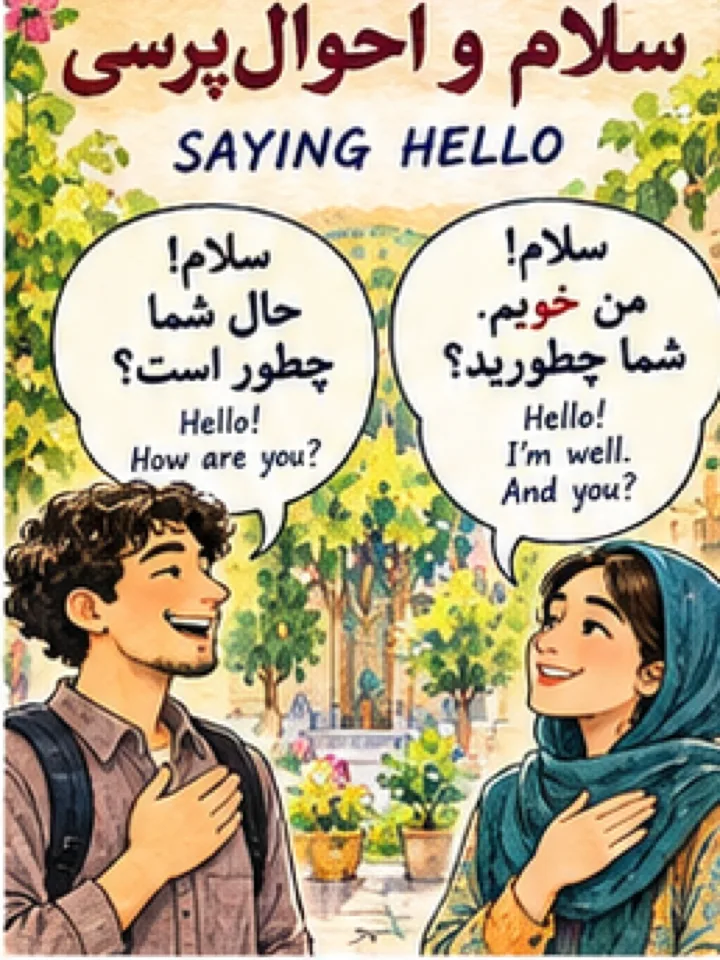
Learn to greet someone in Persian: a short dialogue with salâm and chetori, key phrases, s
greeting ⇒ احوالپرسی

| English | pronunciation | Persian | ||
| Puya: | Hi | /salâm/ | سَلام | :پویا |
| Sara: | Hi | /salâm/ | سَلام | :سارا |
| Puya: | How are you? | /chetori?/ | چطوری؟ | :پویا |
| Sara: | I am fine, and you? | /khobam, to chetori?/ | خوبم ، تو چطوری؟ | :سارا |
| Puya: | I am great, thanks. | /âliyam, mamnon/ | عالیم، ممنون | :پویا |

Learn to greet someone in Persian: a short dialogue with salâm and chetori, key phrases, spoken vs written forms and a quick quiz.
Greetings in Persian: hello and how are you
In this first conversation, Puya and Sara meet and greet each other twice: once with a simple سلام (salâm), "hi", and once in the morning with صبح بخیر (sobh bekheyr), "good morning". Both are friends, so they use the informal "you", تو (to), and the relaxed spoken forms you will hear every day in Iran.
Read each line aloud with the transliteration, then cover the English and try to say what each line means. These few phrases are enough to open almost any casual conversation.
The dialogue
Part 1: a casual hello
| Speaker | Persian | Pronunciation | English |
|---|---|---|---|
| Puya | سلام. | /salâm./ | Hi. |
| Sara | سلام. | /salâm./ | Hi. |
| Puya | چطوری؟ | /chetori?/ | How are you? |
| Sara | خوبم، تو چطوری؟ | /khubam, to chetori?/ | I'm fine. How about you? |
| Puya | عالیم، ممنون. | /âliyam, mamnun./ | I'm great, thanks. |
Part 2: good morning
| Speaker | Persian | Pronunciation | English |
|---|---|---|---|
| Puya | صبح بخیر. | /sobh bekheyr./ | Good morning. |
| Sara | صبح بخیر. | /sobh bekheyr./ | Good morning. |
| Puya | خوبی؟ | /khubi?/ | Are you well? |
| Sara | خوبم. تو خوبی؟ | /khubam. to khubi?/ | I'm fine. Are you well? |
| Puya | منم خوبم. | /manam khubam./ | I'm fine too. |
Key words and phrases
| Persian | Pronunciation | English |
|---|---|---|
| سلام | /salâm/ | hi, hello |
| چطوری؟ | /chetori?/ | how are you? (informal) |
| خوب | /khub/ | good, well |
| خوبم | /khubam/ | I'm fine |
| خوبی؟ | /khubi?/ | are you well? |
| عالی | /âli/ | great, excellent |
| عالیم | /âliyam/ | I'm great |
| ممنون | /mamnun/ | thanks |
| صبح | /sobh/ | morning |
| صبح بخیر | /sobh bekheyr/ | good morning |
| تو | /to/ | you (informal, one person) |
| من | /man/ | I |
| منم | /manam/ | me too, I also |
Spoken vs written Persian
Spoken Persian shortens the verb "to be". Instead of the full هستم (hastam, "I am") and هستی (hasti, "you are"), speakers attach a short ending straight to the adjective: خوبم (khubam), خوبی (khubi). The written forms below are what you would see in a formal text.
| Spoken / written | Pronunciation | Meaning |
|---|---|---|
| چطوری؟ / چطور هستی؟ | /chetori? / chetor hasti?/ | how are you? |
| خوبم / خوب هستم | /khubam / khub hastam/ | I'm fine |
| خوبی؟ / خوب هستی؟ | /khubi? / khub hasti?/ | are you well? |
| عالیم / عالی هستم | /âliyam / âli hastam/ | I'm great |
| منم / من هم | /manam / man ham/ | me too, I also |
Usage notes
تو (to) is the informal "you" for friends, family and children. With strangers, older people or in polite situations, use شما (shomâ) and the matching forms: چطورید؟ (chetorid?) or خوبید؟ (khubid?), "how are you?".
صبح بخیر (sobh bekheyr) is used in the morning only. سلام (salâm) works at any time of day, so it is the safest greeting to learn first. Besides ممنون (mamnun), you will often hear مرسی (mersi) for "thanks" in everyday speech.
Notice that the question and the statement can look the same: خوبی؟ (khubi?) "are you well?" and خوبی "you are well". Only the rising intonation and the question mark tell them apart.
Try it yourself
- Greet a friend in the morning and ask if they are well: صبح بخیر، خوبی؟ (sobh bekheyr, khubi?).
- Answer that you are great and thank them: عالیم، ممنون (âliyam, mamnun).
- Reply "me too" when someone says they are fine: منم خوبم (manam khubam).
- Now redo the whole exchange politely with شما, as if you were greeting a teacher: سلام، خوبید؟ (salâm, khubid?).
Practice
-
How do you say "good morning" in Persian?
Show answer
sobh bekheyr صبح بخیر
-
A friend asks you {{چطوری؟}}. Say that you are fine and ask back.
Show answer
khubam, to chetori? خوبم، تو چطوری؟
-
What does Puya mean by {{عالیم، ممنون}}?
Show answer
I'm great, thanks.
-
Write the formal written form of {{منم خوبم}}.
Show answer
man ham khub hastam من هم خوب هستم
-
Which word for "you" would you use with your teacher?
Show answer
shomâ, the polite form شما
Find more dialogues in the Farsi conversation lessons series, and review the sounds behind the transliteration on the Persian pronunciation page.
| English | pronunciation | Persian | ||
| Puya: | Good morning. | /sobh behkhyer/ | صبح بخیر | :پویا |
| Sara: | Good morning. | /sobh bekhyer/ | صبح بخیر | :سارا |
| Puya: | Are you fine? | /khobi?/ | خوبی؟ | :پویا |
| Sara: | I am fine, are you fine? | /khobam, to khobi?/ | خوبم. تو خوبی؟ | :سارا |
| Puya: | I am fine too. | /manam khobam/ | .منم خوبم | :پویا |
Common questions
How do you say “How are you?” in Persian?
Informally چطوری؟ (chetori?); politely حال شما چطور است؟ (hâl-e shomâ chetor ast?).
How do you answer “chetori”?
خوبم، تو چطوری؟ (khubam, to chetori?), “I’m fine, and you?”
How do you say good morning?
صبح بخیر (sobh bekheyr).
What does عالیم (âliyam) mean?
- I’m sad
- I’m great
- I’m tired
- I’m late
عالیم, I’m great.
Which “you” do friends use?
- شما
- تو (to)
- او
- ما
Friends use informal تو.
How do you say “hi”?
- خداحافظ
- سلام (salâm)
- ممنون
- ببخشید
سلام.


Take this lesson further
Study with the book
Farsi Conversations: Learn the Most Common Words and Phrases Farsi Speakers use Every Day
This free lesson is part of Farsi conversation lessons. The book puts the whole series in one printable PDF you can study offline.
Serious about Persian? Get all 30 of our Persian learning books for $149.00 (55% less than buying them one by one).
Free Persian Starter Kit (PDF)
The Persian alphabet chart and the 101 most common Persian words with pronunciation, in one printable PDF. You also get a one-time 15% code for any of our books.
We will email you new lessons and book news from Learn Persian Online. Unsubscribe any time.Free: 100 Core Persian Words + 20 Survival Phrases
Get the 14-page printable Starter Pack (all 32 letters, a 7-day reading plan, 100 core words and 20 survival phrases) and a short 5-email course. Free.