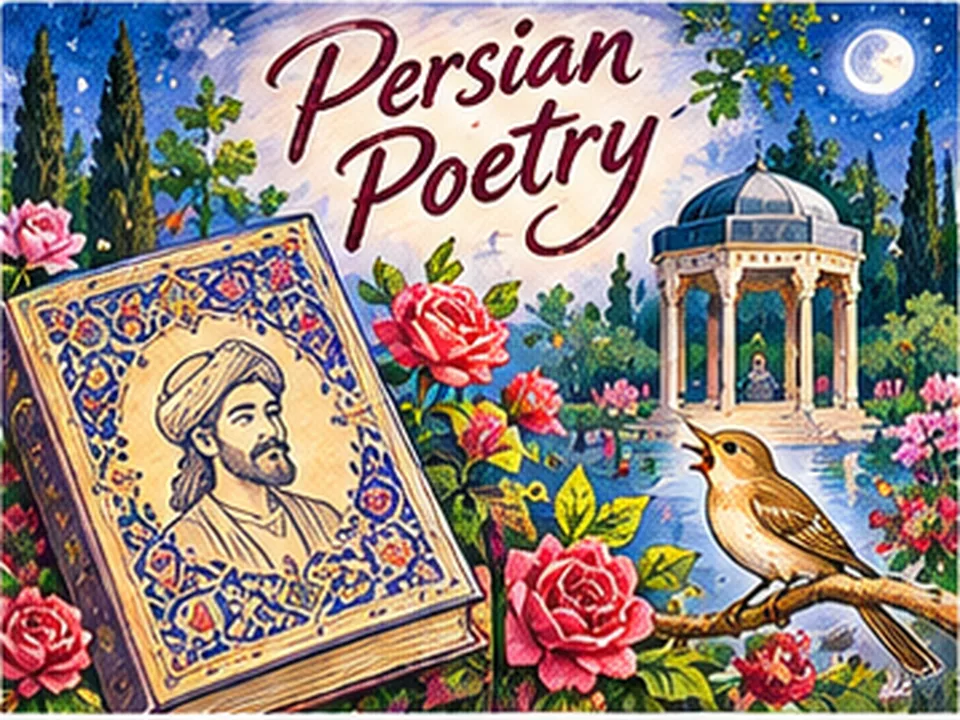
Persian is a lovely, elegant, and romantic language and poetry is an essential piece of it. For centuries, the world’s most influential and inspiring poets, whose works attracted many people in the world, have been living in Persian-speaking countries. Therefore, Persian poetry is a unique breed. It’s full of life, love, and romantic phrases and everything beyond.
This section is a collection of the greatest poems of Persian literature ever written. The page includes the most beautiful poems by the greatest Persian poets as Rumi, Hafez, and Saadi, etc. These poems can be useful for students and enjoyable for poetry lovers of any age.
Not only will poems improve your Persian language, but they’ll help your understanding of Persian culture. Students will have ample opportunities to enrich their Persian learning experience and extend a range of language abilities through exploring these poems.


An introduction to reading Persian poetry for learners: meter, rhyme, ezâfe, archaic forms and how to read a couplet, with a famous example.
How to read Persian poetry
Poetry, شعر (she'r), is everywhere in Iran: on tombs and walls, in songs and in everyday conversation. Reading it is rewarding but different from reading prose. This short guide explains the main features you need to notice, then walks through one of the best-known couplets in the language.
Basic terms
| Persian | Pronunciation | English |
|---|---|---|
| بیت | /beyt/ | couplet, two half-lines read as one unit |
| مصراع | /mesrâ'/ | hemistich, one half-line of a couplet |
| وزن | /vazn/ | meter, the rhythm of long and short syllables |
| قافیه | /ghâfiye/ | rhyme |
| ردیف | /radif/ | refrain, words repeated after the rhyme at the end of each line |
| غزل | /ghazal/ | ghazal, a short lyric poem, usually about love |
| رباعی | /robâ'i/ | quatrain, a four-line poem |
| مثنوی | /masnavi/ | a long poem in rhyming couplets |
| تخلص | /takhallos/ | the poet's pen name, often used in the last couplet of a ghazal |
Meter
Classical Persian poetry is measured, not counted. Each line follows a fixed pattern of long and short syllables, its وزن (vazn). A syllable is long if it has a long vowel (â, i, u) or ends in a consonant, and short if it is a short vowel (a, e, o) with no following consonant in the same syllable. You do not need to scan every line, but reading slowly and stretching the long syllables helps you find the rhythm, and the rhythm often tells you how a word must be pronounced.
Ezâfe and small sounds
The ezâfe, the linking -e or -ye between a noun and its modifier, is rarely written but always counts in the meter. If a line seems to have a syllable missing, an unwritten ezâfe is often the answer. The conjunction و, "and", is usually read o, not va.
Archaic forms to recognize
| Persian | Pronunciation | English |
|---|---|---|
| ز | /ze/ | from, of (modern از) |
| گر | /gar/ | if (modern اگر) |
| چو / چون | /cho / chon/ | when, as, like |
| همی | /hami/ | old prefix for continuous action (modern می) |
| بود | /bovad/ | is, will be (classical form; modern است or باشد) |
| که | /ke/ | who, which, that; also "because, for" |
Reading a couplet step by step
Here is the opening couplet of Rumi's Masnavi, مثنوی, one of the most famous lines in Persian. It is also often quoted with بشنو از نی (beshno az ney), "listen to the reed", at the start:
| Persian | Pronunciation | English |
|---|---|---|
| بشنو این نی چون شکایت میکند | /beshno in ney chon shekâyat mikonad/ | Listen to this reed, how it complains; |
| از جداییها حکایت میکند | /az jodâyi-hâ hekâyat mikonad/ | it tells a tale of separations. |
- Find the rhyme and the refrain: شکایت (shekâyat) rhymes with حکایت (hekâyat), and میکند (mikonad) is repeated after them as the refrain.
- Find the meter: each half-line follows the pattern long-short-long-long, long-short-long-long, long-short-long. Try tapping it: besh-no-in-ney / chon-she-kâ-yat / mi-ko-nad.
- Look for archaic forms: بشنو (beshno), "listen", is the poetic imperative, and چون (chon) here means "how".
- Read the meaning: the reed flute, cut from its reed bed, is a classic image of the soul longing to return to its origin.
In a ghazal, both half-lines of the first couplet rhyme; after that, only the second half-line of each couplet carries the rhyme and refrain. Each couplet is usually complete in itself, so read one couplet at a time and make sense of it before moving on. In the last couplet, look for the poet's pen name, such as حافظ (hâfez) or سعدی (sa'di).
Related pages
- Saadi's tomb in Shiraz: vocabulary and a reading
- Persian reading lesson 21: Omar Khayyam
- Persian reading lesson 19: Shiraz, city of Saadi and Hafez
- Persian Idioms and Proverbs
Practice
What is a "beyt"? بیت
Show answer
a couplet: two half-lines read as one unit
What is the modern form of this poetic word? ز
Show answer
az, "from, of" از
In the Rumi couplet, which words rhyme and which word is the refrain?
Show answer
shekâyat and hekâyat rhyme; mikonad is the refrain. شکایت / حکایت ؛ میکند
Where does a ghazal poet usually put his pen name?
Show answer
in the last couplet
Does the unwritten ezâfe count in the meter?
Show answer
Yes, it is pronounced and counts as a syllable.
Explore more: Persian reading lessons.
Common questions
Who are the greatest Persian poets?
Ferdowsi, Rumi, Saadi, Hafez and Omar Khayyam are the best known; Nezami, Attar and Jami are also widely read.
How should I start reading Persian poetry?
Begin with short, famous lines in a bilingual edition, learn the key words, and read them aloud to feel the rhythm.
Is classical Persian poetry hard to read?
Its words are mostly still in use, so modern readers can follow much of it, but the style and allusions need notes at first.
Which poet wrote the Shahnameh?
- Hafez
- Ferdowsi
- Rumi
- Khayyam
Ferdowsi finished the Book of Kings in 1010.
What is a ghazal?
- a short lyric poem, usually about love
- a long epic
- a four-line poem
- a prose story
The ghazal is a lyric of about 7 to 15 couplets; Hafez is its master.
What is a robâ’i (rubai)?
- a quatrain, a four-line poem
- a couplet
- a sonnet
- a song
Khayyam is famous for his رباعی (quatrains).
Take this lesson further

Serious about Persian? Get all 30 of our Persian learning books for $149.00 (55% less than buying them one by one).
Free Persian Starter Kit (PDF)
The Persian alphabet chart and the 101 most common Persian words with pronunciation, in one printable PDF. You also get a one-time 15% code for any of our books.
We will email you new lessons and book news from Learn Persian Online. Unsubscribe any time.Love Persian poetry? Learn to read it: free Starter Pack
Get the 14-page printable Starter Pack (all 32 letters, a 7-day reading plan, 100 core words and 20 survival phrases) and a short 5-email course. Free.